Return to Biological Rhythm in a World Without Time
Dr. Silvia Samarin, MD, PhD ·
Circadian Biology & Performance Systems ·
Slovenia ·
research@escapeprotocol.com
Original scientific frameworks in chronobiological supplementation,
collagen biology, circadian medicine, and longevity.
All research is open access, independently conducted, and freely available.
02Circadian Supplementation Systems (CSS): Defining a New Category of Dietary InterventionUnder Review
03Subjectively Perceived Effects of a Chronobiologically Timed Multi-Ingredient Dietary Supplement System After 30 Days: A Pilot Observational StudyUnder Review
The human circadian clock has an intrinsic period of approximately 24 hours and 10-12 minutes and must be reset every day by external time signals called Zeitgebers. Modern indoor life has systematically eroded these signals - artificial light eliminates light-dark contrast; irregular meal timing removes the feeding Zeitgeber; sedentary work removes the activity signal. The consequence is chronic circadian desynchronisation, documented in 59-80% of the working population as social jet lag (Roenneberg et al. 2012). Circadian disruption is now recognised as an independent risk factor for metabolic, cardiovascular, cognitive, and inflammatory pathology. Supplements that ignore timing cannot address a timing problem.
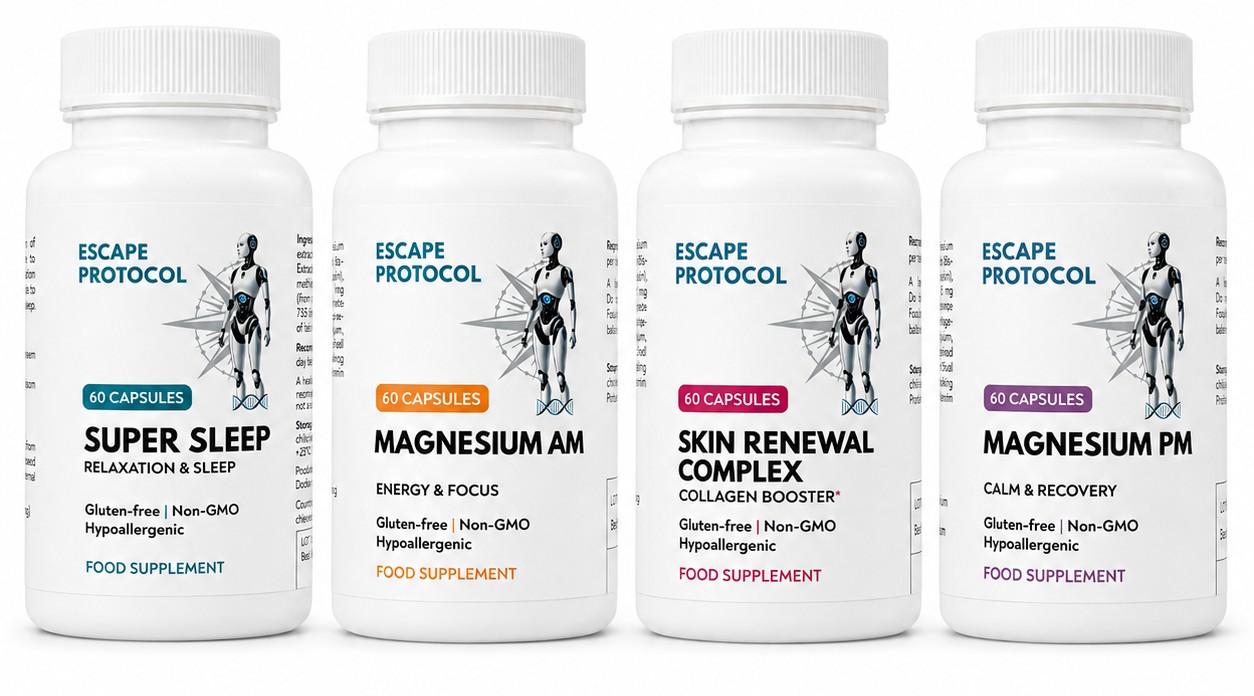
The EscapeMed 30D system is, to the authors' knowledge, the first dietary supplement architecture coordinating 30 active ingredients across four timed formulas and five biological layers as a single 24-hour biological programme - functioning simultaneously as a nutritional intervention and a behavioral Zeitgeber architecture. This paper introduces a novel three-category dose taxonomy (Repletion, Cofactor-calibrated, Signal), documents complete intra-formula and cross-formula synergy mechanisms, proposes the first formal Seasonal Supplementation Hypothesis with pro/contra argumentation, and reports 30-day pilot observational data from 20 participants showing 90% wellbeing improvement, 75% sleep quality improvement, and 80% energy improvement. A consistent early adaptation signature in 50% of participants is identified as the first population-level circadian resynchronisation marker from a multi-formula chronobiological supplement system.
Keywords: chronobiology · EscapeMed 30D · signal logic · circadian supplementation · magnesium · melatonin microdose · collagen synthesis · sleep architecture · Zeitgeber · social jet lag · dose taxonomy · seasonal supplementation · longevity · healthspan · pilot study
Cite as
Samarin, S. (2026). The EscapeMed 30D System: Signal Logic, Dose Rationale, and Pilot Evidence. A Four-Formula, 30-Ingredient Chronobiological Architecture Across Five Biological Layers. Escape Protocol Research. doi: forthcoming.
Theoretical Foundation · New Category Paper
Circadian Supplementation Systems (CSS): Defining a New Category of Dietary Intervention Beyond Nutritional Completeness and Habit Simplification
Silvia Samarin, MD, PhDEscape Protocol Research2026Under Review · Chronobiology International
Abstract
[INSERT ABSTRACT FROM CSS NEW CATEGORY PAPER HERE — paste the full abstract text replacing this line]
Keywords: circadian supplementation systems · new supplement category ·
chronobiology · dietary intervention · nutritional completeness ·
habit simplification · signal logic · Zeitgeber · circadian medicine
Under peer review · Chronobiology International
Cite as
Samarin, S. (2026). Circadian Supplementation Systems (CSS): Defining a New Category of Dietary Intervention Beyond Nutritional Completeness and Habit Simplification. Chronobiology International (under review). Escape Protocol Research.
EscapeMed 30D Research Series · Paper 1 · Pilot Study
Subjectively Perceived Effects of a Chronobiologically Timed Multi-Ingredient Dietary Supplement System After 30 Days: A Pilot Observational Study
Silvia Samarin, MD, PhDEscape Protocol Research2026Pilot Study · Under Review - Journal of Dietary Supplements
Abstract
A single-arm, open-label pilot observational study examining the subjective effects of the complete EscapeMed 30D four-formula chronobiological supplement system over 30 days in 20 adult volunteers. Primary outcomes assessed via validated Likert-scale questionnaire at baseline and Day 30: overall wellbeing, sleep quality, and energy levels. Results: wellbeing improved in 90% of participants (+37% mean score change); sleep quality in 75% (+33%); energy in 80% (+31%). No participant declined on any primary measure. A consistent early adaptation signature - increased dream vividness and transient afternoon fatigue during days 3-5 - was observed in 50% of participants and is mechanistically attributed to glycine-driven REM density increase and ashwagandha-mediated HPA axis normalisation. This pattern is identified as the first documented population-level circadian resynchronisation marker from a multi-formula chronobiological supplement system. Findings are presented as hypothesis-generating evidence; no controlled trial of the complete system currently exists.
Cite as
Samarin, S. (2026). Subjectively Perceived Effects of a Chronobiologically Timed Multi-Ingredient Dietary Supplement System After 30 Days: A Pilot Observational Study. Journal of Dietary Supplements (under review). Escape Protocol Research.
EscapeMed 30D Research Series · Paper 2 · Formulation Rationale
Circadian Phase-Specific Magnesium Supplementation Using Multiple Salt Forms
The EscapeMed 30D system is, to the author's knowledge, the first dietary supplement architecture to coordinate 30 active ingredients across four phase-specific formulas and five biological layers as a single integrated daily chronobiological protocol. This narrative review documents the scientific rationale for the dual AM/PM magnesium layer of this system: five distinct magnesium salt forms selected for morning administration and five for evening administration, based on differential bioavailability, tissue affinities, counterion biological functions, and alignment with circadian phase-specific physiological demands.
Six tables are presented: the AM vs PM architectural comparison; biological layer coverage by formula; symptom-to-mechanism mapping; a structured comparison of single-salt versus multi-salt supplementation; a target population guide; and a clinical decision framework for single-formula use. All ingredient doses are confirmed from the official product specification and presented at both one-capsule and two-capsule levels to reflect the system's flexible dosing architecture.
The AM/PM magnesium architecture is, to the author's knowledge, the first dual-phase, multi-salt magnesium formulation to be documented in peer-reviewed literature.
Cite as
Samarin, S. (2026). Circadian Phase-Specific Magnesium Supplementation Using Multiple Salt Forms. Escape Protocol Research. MetaArXiv preprint. doi: forthcoming.
EscapeMed 30D Research Series · Paper 3 · Formulation Rationale
Skin Renewal Complex: A Chronobiologically Timed 14-Ingredient Formula for Collagen Synthesis, Connective Tissue Support, and Cellular Protection
Collagen is the most abundant protein in the human body, constituting approximately 30% of total protein mass and forming the structural backbone of skin, bone, cartilage, tendons, ligaments, blood vessels, and every organ capsule. Despite the commercial prominence of the collagen supplement category — dominated by hydrolysed peptides from bovine and marine sources — the scientific literature establishes that exogenous collagen fragments are not incorporated directly into new collagen fibers. The body synthesises its own collagen from dietary amino acid substrates using a cascade of enzymatic reactions that require specific cofactors at every step. A deficiency in any single cofactor halts the entire synthesis pathway regardless of substrate availability or collagen peptide intake.
Skin Renewal Complex is a 14-ingredient formula designed to provide the complete cofactor network for endogenous collagen synthesis and connective tissue maintenance, combined with comprehensive cellular antioxidant protection, extracellular matrix hydration support, and a chronobiologically informed midday administration time anchored to the post-cortisol-decline window of peak fibroblast activation. Six tables document the formulation: major collagen types and tissue distribution; the collagen synthesis pathway and its cofactor requirements; the complete ingredient architecture at both flexible dose levels; biological layer coverage; target population guide; and symptom-to-mechanism mapping. This paper is, to the authors' knowledge, the first peer-reviewed documentation of a chronobiologically timed, complete-cofactor connective tissue support formula grounded in fibroblast circadian biology.
Cite as
Samarin, S. (2026). Skin Renewal Complex: A Chronobiologically Timed 14-Ingredient Formula for Collagen Synthesis, Connective Tissue Support, and Cellular Protection. Escape Protocol Research. MetaArXiv preprint. doi: forthcoming.
EscapeMed 30D Research Series · Paper 4 · Formulation Rationale
Super Sleep: A Circadian Resynchronisation Formula Based on Multi-Mechanism Non-Sedative Sleep Architecture Support
Poor sleep quality is among the most prevalent functional complaints in modern Western populations, yet the dominant supplementation and pharmaceutical response — sedation — addresses a symptom while bypassing the underlying circadian biology. Super Sleep is an eight-ingredient, non-sedative evening formula designed as the night phase component of the EscapeMed 30D chronobiological supplement system. Its formulation logic rests on three biological arguments: sleep onset failure in the majority of healthy adults is not a sedation deficit but a failure of circadian resynchronisation; this failure is population-level in scale, affecting an estimated 60–80% of the modern working population through social jet lag and chronic circadian drift; and it can be addressed through GABAergic tone support, HPA axis normalisation, and tryptophan-melatonin pathway activation without sedation.
Seven tables document the complete formulation in logical sequence: global epidemiology of sleep insufficiency; sleep architecture phases with biological functions and formula coverage; ingredient architecture at both flexible dose levels; target population guide identifying who benefits most and why; symptom-to-mechanism mapping; comparison to conventional sleep aids; and a distinction between medical sleep disorders and biological misalignment. All ingredient doses are confirmed from the official product specification at both one-capsule and two-capsule levels. Super Sleep is, to the authors' knowledge, the first multi-mechanism, non-sedative sleep architecture formula to be documented in peer-reviewed literature within a defined chronobiological supplement system.
Keywords: melatonin microdose · sleep architecture · social jet lag · GABA-A · NMDA · circadian entrainment · ashwagandha · tryptophan · CYP1A2 · chronobiology · signal dose
Cite as
Samarin, S. (2026). Super Sleep: A Circadian Resynchronisation Formula Based on Multi-Mechanism Non-Sedative Sleep Architecture Support. Escape Protocol Research. MetaArXiv preprint. doi: forthcoming.
EscapeMed 30D Research Series · N=1 Case Report · 840 Nights
Better Deep Sleep Under More Stress: Behind the Paradox
Architecture, Timing, and Genomics in an N=1 840-Night Case Report Using WHOOP 4.0 + Oura Ring Gen 3
A 54-year-old morning-chronotype perimenopausal physician recorded her best deep sleep in 840 nights of continuous tracking during her most demanding professional period. Sleep was tracked via simultaneous dual wearable devices — WHOOP 4.0 and Oura Ring Generation 3 — across four sequential supplement protocol phases: Baseline unstructured stack (n=447), Phase 1 Super Sleep (n=85), Phase 2 +Skin Renewal Complex (n=223), Phase 3 full EscapeMed 30D (n=84). Each architectural phase produced progressive improvement. The largest single step change (SWS +15.7 min, Restorative% from 33.1% to 45.8%) occurred when the first timed formula replaced randomly-timed supplementation of the same core molecules — timing was the intervention.
High-quality nights (Restorative% ≥50% AND Efficiency ≥93%) rose from 0% at baseline to 33.3% in Phase 3, which coincided with peak professional demand and shortest time in bed. Whole-genome sequencing identified five variants of mechanistic relevance: ESR1 C/C (perimenopausal Mg wasting), NQO1 HET Likely Pathogenic (reduced antioxidant capacity), MTHFR HET (B6 conversion), COL1A1 (collagen synthesis demand), CYP1A2 HET (intermediate melatonin metabolizer — 0.20mg signal dose pharmacogenomically appropriate). The paradox resolves when the architecture is understood.
Cite as
Samarin, S. (2026). Better Deep Sleep Under More Stress: Behind the Paradox — Architecture, Timing, and Genomics in an N=1 840-Night Case Report. Escape Protocol Research. Preprint. escapeprotocol.com/better-deep-sleep.html
Escape Protocol Research · Autonomic Biology · N=1 Case Report · 840 Nights
Chronically Low HRV: Constitutional Phenotype or Correctable Problem?
Genomics, Autonomic Architecture, and 840 Nights of Dual-Device Evidence
A cardiology-informed N=1 case report examining 834 clean nights of simultaneous dual-device HRV data (WHOOP 4.0 + Oura Ring Gen 3) in the context of whole-genome sequencing, providing a framework for distinguishing constitutional from correctable low HRV. Mean RMSSD 19.8 ms (WHOOP) and 16.3 ms (Oura) — consistently below the 10th population percentile for age across the full 840-night observation period regardless of supplement phase, season, or optimisation effort.
Whole-genome sequencing identified two variants with direct functional relevance: GRK5 rs10886471 (homozygous) — altered GPCR desensitisation kinetics; and ADRB2 rs1042713 Arg16Gly (heterozygous) — documented lower sympathetic HRV indices in Arg16 carriers. Major cardiac ion channels (HCN4, KCNQ1, SCN5A) confirmed at reference genotype. Supplement phase analysis shows a directional trend (nights below 20 ms falling from 62% to 30% across four phases) without reversal of the constitutional setpoint. Clinical framework provided for five practical questions: how to distinguish constitutional from situational low HRV, whether it is dangerous, what can and cannot move the number, what to do when no genomic explanation is found, and when a cardiology evaluation is warranted.
Skin Fitness introduces a new paradigm that views the skin as a dynamic, trainable organ. Inspired by exercise physiology, the concept applies training principles — progressive stimulation, recovery, and synchronisation — to the dermal collagen network. Recent chronobiology research shows that fibroblast activity, collagen synthesis, and antioxidant defences follow circadian oscillations, peaking in the late morning (approximately 08:00–11:00) as cortisol declines from its early-morning apex. Aligning regenerative interventions with this biological window may enhance skin repair, matrix organisation, and overall dermal longevity.
The Skin Fitness Model is structured around seven adaptive principles: stimulation, intensity cycling, comprehensive activation, nutrient supply, regeneration, hormonal balance, and consistency. Controlled micro-injury serves as the key training stimulus, awakening fibroblasts and initiating renewal. The active stimulation phase corresponds to the late-morning window when cortisol naturally declines and fibroblast responsiveness peaks — the optimal biological timing for regenerative treatments such as microneedling or energy-based therapy. The night-time phase represents the intrinsic regeneration period, dominated by growth hormone and IGF-1 activity that drives collagen synthesis.
Long-term clinical observation demonstrated visible improvements in dermal tone, elasticity, and contour when interventions followed these temporal and biological cues. Skin Fitness reframes rejuvenation as a biological training system grounded in chronobiology, bridging regenerative medicine, nutrition, and aesthetic science — providing a new foundation for rhythm-synchronised, personalised anti-ageing protocols that train the skin to regenerate as a living, adaptive system.
Cite as
Samarin, S. (2026). Skin Fitness: A Chronobiology-Inspired Framework for Collagen Training and Fibroblast Activation. Poster presented at AMWC — Aesthetic and Anti-Aging Medicine World Congress, Monaco, 2026. Abstract #13118.
A plain-language scientific review explaining how collagen is manufactured inside fibroblast cells, what magnesium contributes at each step, and why the form and timing of magnesium supplementation changes the outcome. Built on independent peer-reviewed research: Chalupczak & Lipner, JAAD Reviews 2026 — the first comprehensive clinical review of magnesium's role in dermatology.
Key findings from the independent JAAD paper: magnesium drives fibroblast migration, reduces collagen-degrading inflammation (TNF-α and IL-6) by 20–25%, powers antioxidant enzymes (superoxide dismutase, glutathione peroxidase), improves skin barrier function (19% reduction in water loss), and has Level I clinical trial evidence for wound healing. The article traces the 6-step collagen synthesis cascade and explains why Vitamin C is an absolute — not optional — cofactor at Step 3. Without it, the collagen chain cannot stabilise and is discarded.
Cite as
Samarin, S. (2026). Magnesium and Collagen: What Happens Inside Your Skin Cells, and Why the Form of Magnesium You Take Changes the Outcome. Escape Protocol Research. escapeprotocol.com/magnesium-collagen.html
In preparation
Skin Fitness: A Biological Framework for Structural Skin Health
Collagen cycling, fibroblast biology, and the inside-out architecture of skin ageing
Perimenopause is one of the most complex and consistently underaddressed biological transitions in women's medicine. This narrative review introduces the Perimenopause Chain: nine interconnected biological systems — circadian clock, sleep architecture, HPA axis and cortisol rhythm, insulin sensitivity and metabolism, cardiovascular function, collagen and connective tissue, muscle mass and body composition, neurological stability, and thyroid function — each governed by two master signals: sex hormones (estrogen, progesterone, testosterone) and thyroid hormones. When either governing signal becomes dysrhythmic, the chain weakens link by link. The chain is only as strong as its weakest link.
A central and non-negotiable principle: no dietary supplement restores hormones. The HRT triad — bioidentical estradiol, micronised progesterone, and testosterone — each contribute distinct, non-redundant biological effects that no supplement can replicate. A clinical laboratory protocol with 29 reference values compares standard ranges against optimal perimenopausal targets. Six theoretical intervention models (M1–M6) compare expected chain outcomes at 12 months. A 30-day pilot observational study (N=20) provides preliminary hypothesis-generating data showing 90% wellbeing improvement, 75% sleep quality improvement, and 80% energy improvement. A patient quick-reference guide translates the clinical framework into practical tools for the consulting room. Written simultaneously for the menopause specialist, the general practitioner, and the perimenopausal woman herself.
Cite as
Samarin, S. (2026). The Perimenopause Chain: A Biological Framework for Understanding and Optimising the Hormonal Transition. Escape Protocol Research. Preprint. escapeprotocol.com/perimenopause-chain.html
Domain 03
Circadian Medicine & Protocols
In preparation
The Seasonal Reset Hypothesis: Annual Circadian Architecture and Structured Supplementation Cycles