
Human biology changes across the day; most supplementation does not. Thirty active ingredients can be arranged three ways — bought as thirty separate products, blended into a single daily scoop, or split into four formulas taken in two windows. This article compares all three on published label data, sets out what the biology of timing does and does not support, states plainly where the evidence runs out, and argues that the arrangement decides more than the ingredient list does.
Keywords: supplement timing · chrononutrition · comparative analysis · dose vs ingredient · magnesium salt forms · elemental magnesium · melatonin signal dose · proprietary blends · capsule vs powder · adherence · social jetlag · shift work · EFSA reference levels · AG1 · IM8 · Longevity Complete · Blueprint Longevity Mix · EscapeMed 30D
—You are not the same person all day
You are not the same biological person at seven in the morning that you are at ten at night. Your supplement usually behaves as if you are.
That is meant literally. The hormone that wakes you, the hormone that lets you sleep, your body temperature and the hormone that repairs you overnight each peak at a different hour. Not one of them stays level across the day.
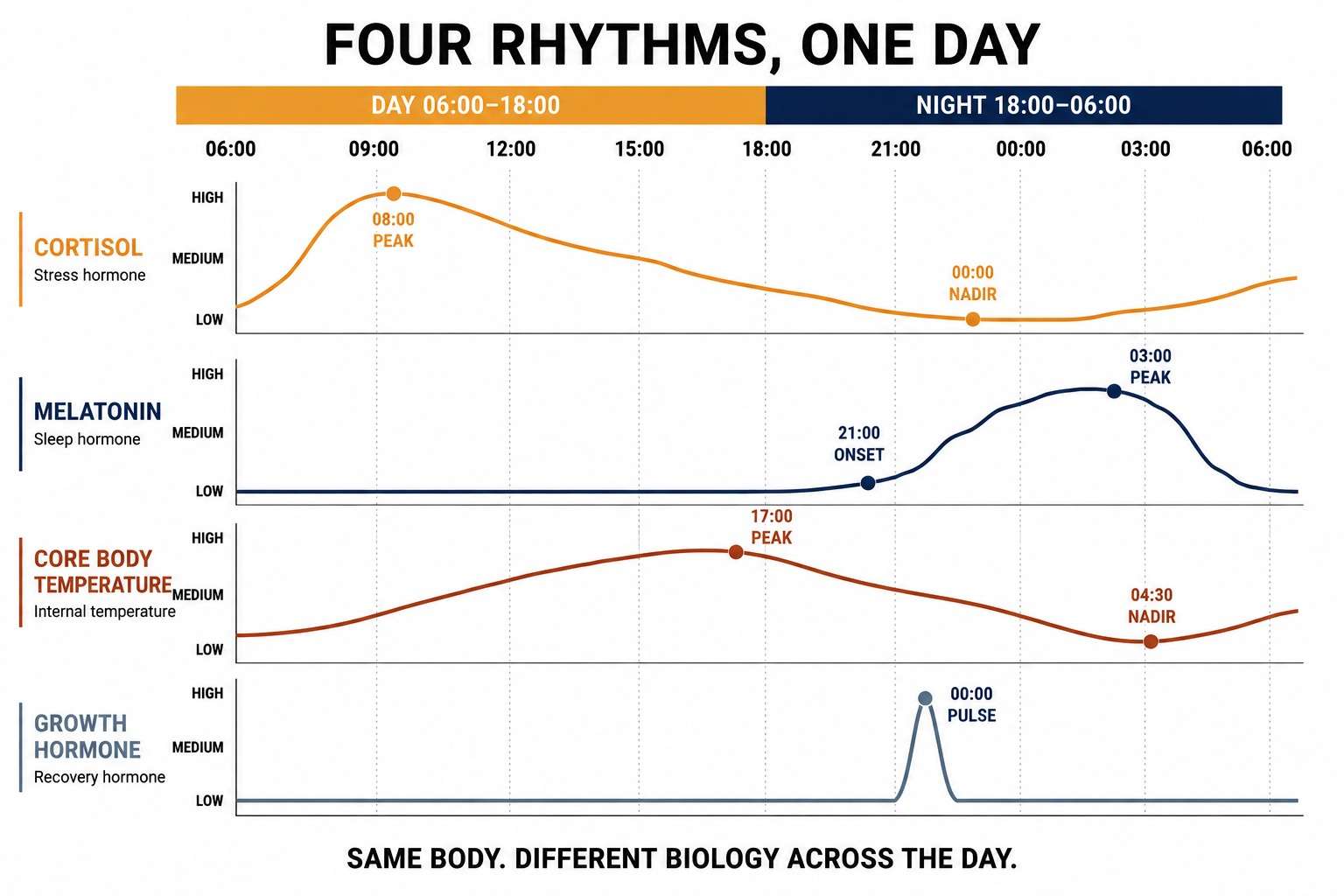
Four rhythms, one day. Cortisol peaks within an hour of waking and is at its lowest around midnight. Melatonin does the opposite. Core temperature peaks in the late afternoon and bottoms out before dawn. Growth hormone is almost absent all day and arrives as a single pulse in the first deep-sleep episode. Four systems, four schedules, one body.
We accept this everywhere else without needing it explained. We do not eat dinner for breakfast or drink espresso before bed. Medicine is prescribed by the hour — corticosteroids in the morning to sit with the body's own cortisol rhythm, thyroid medication on an empty stomach because food reduces how much of it is absorbed — and a patient who ignores the instruction simply gets less of the drug.
Supplements are the one category where that intuition was quietly dropped. The standard is a single serving, taken once, at whatever hour is convenient, in the same amount for everyone, for years. That format was organised around ease of delivery rather than around biology, and the strangeness of it only becomes visible when you put it next to breakfast.
If human biology changes across twenty-four hours, should supplementation ignore the clock?
The short answer
No. But taking biological timing seriously should not make supplementation harder to live with. A system only works if a person can actually follow it — through travel, bad weeks, changing schedules and ordinary life. Most people do not take supplements in the morning; they take them when they remember, which is a different thing. So the aim is not more dosing decisions. It is fewer, and better placed.
Two anchors already exist in every day: when you wake, and before you sleep. Your morning capsules when you get up, your evening capsules before bed. That is the whole routine. Complexity belongs in the formulation, not in the routine.
Complex biology. Simple decisions.
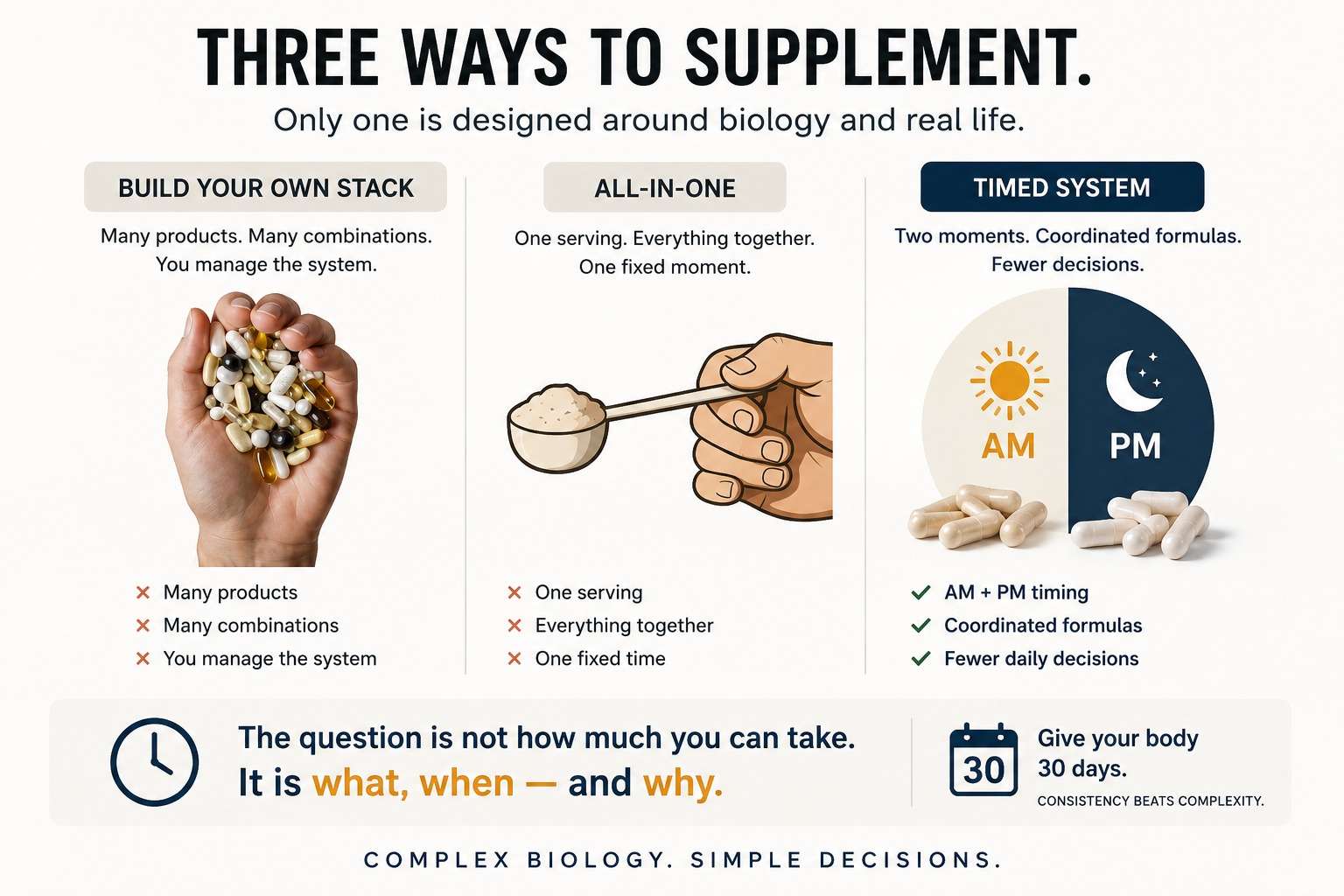
Three ways to supplement. These are the only three arrangements available, and almost everyone reading this is using one of them. Build your own stack and you have complete control over every form and amount — and you also become the person responsible for counting the totals, which in practice nobody does. Take an all-in-one and the management disappears, but so does any ability to adjust: one serving, one hour, the same amount for everyone. A timed system sits between the two: coordinated formulas, a small number of fixed decisions, and two moments in the day rather than one. Nothing about the ingredients changes across these three panels. What changes is how many decisions you make each day, whether anything is counting the totals, and how much of the day is covered.
What follows is an attempt to answer that question honestly, including the parts where the honest answer is that nobody knows, and the parts where it costs us something to say so. Every figure here comes from a published label or a published paper and can be checked. The thirty ingredients discussed are not unusual. What is worth arguing about is how they are arranged — and the question matters most to the people whose day is not the standard one, which is where this article begins.
—Executive summary
The whole argument in one page, for anyone who has three minutes. The full analysis follows, and everything asserted here is evidenced there.
The three real options
| Arrangement | What it is | What it cannot do |
|---|---|---|
| A self-built stack | The shelf most people already own, built one purchase at a time | Nobody counts the totals; in practice everything gets taken at once anyway |
| One all-in-one scoop | 75–90 named ingredients in a single morning serving | One fixed dose, one fixed hour, and nothing working in the evening |
| Four formulas, two moments | Thirty actives across five biological systems, split into a morning and an evening window | Fewer total ingredients, and no gram-scale actives such as creatine or fibre |
The ingredients are not the variable. The arrangement is.
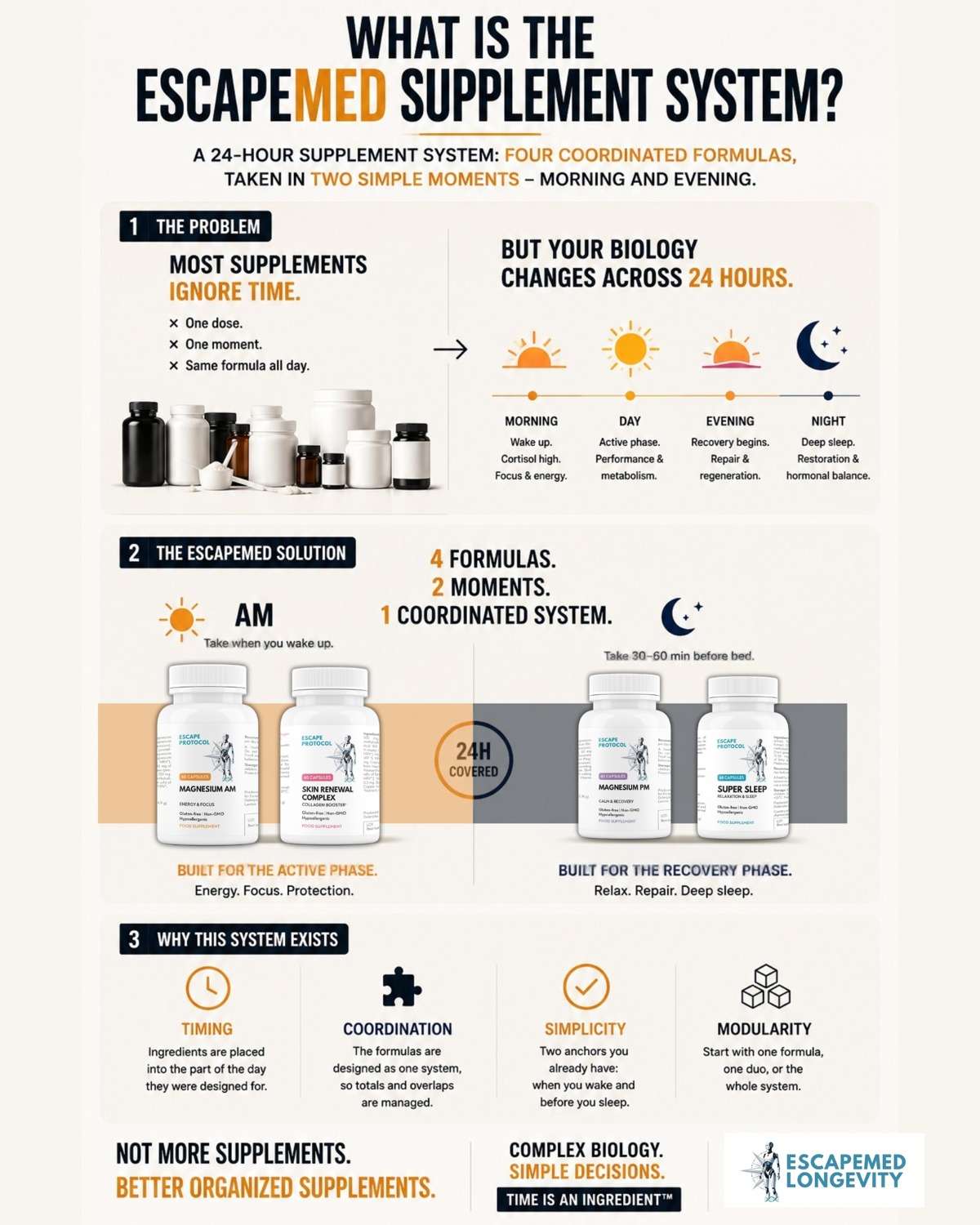
What the third arrangement actually is. Most supplements are dosed as though the day were uniform — one amount, one moment, the same formula from waking to sleep. The body is not uniform: cortisol and alertness run the morning, recovery and repair run the evening, and the two need different things. So the thirty actives are split into four formulas built for the phase they belong to, and those four are taken in two moments that already exist in every day. Four formulas, two moments, one coordinated system — and you can start with one formula, one duo, or all four.
Why the third one
- The evening is empty in the others. Eight actives work after 18:00 here. In the products with seventy-five and ninety ingredients, that number is zero — they are morning products.
- Depth where a buyer actually cares. Fourteen actives on skin and connective tissue against five or six. Eight magnesium forms against one or two. 250–500 mg of elemental magnesium — the magnesium itself, not the weight of the salt carrying it — against roughly 56.
- It can leave things out. Magnesium taurate is deliberately kept out of the morning formula, malate and succinate out of the evening one. A single serving has to contain everything at once — it can add, but it can never withhold.
- You set the dose. Four capsules or eight, at the same cost per capsule, changed whenever your training, season or life changes. A scoop has one setting, for everyone, forever.
- Something counts the totals. Across the whole system — magnesium held at a defined level and split, B6 tracked across four formulas, zinc weighed against copper. A shelf of open bottles cannot do this.
- It is the easiest to keep doing. Two moments, seconds each. No water beyond a glass, no shaker, no washing up, no taste, nothing to spill in a suitcase. Adherence is what decides whether any supplement does anything.
- Every amount printed, and a name on it. No proprietary blends. Formulated by a named MD, PhD across six published papers, and run on her own biology for 840 consecutive tracked nights before it was offered to anyone.
Three claims, limited to the products compared in this article, each checkable against the same published labels used throughout.
- 1. It is the only one that decides what to leave out of each phase. Magnesium taurate is withheld from the morning formula; malate and succinate are withheld from the evening one. Adding an ingredient is available to every brand. Keeping one out of a phase requires more than one formula, which a single serving does not have.
- 2. It is the only one where the dose is yours rather than the formulator's. One capsule or two, per formula, at the same cost per capsule — and any formula can be bought and taken on its own. Every other product here has one serving size, for everyone, permanently.
- 3. It is the only one with anything working after 18:00. Eight actives in the evening phase. In the four comparison products that number is zero in the base formula — not an oversight, but what a single morning serving structurally cannot reach.
Everything else in this article is argument and evidence. These three are simply true of the products compared, and section 06 shows the labels they come from.
And what it will not do
It will not replace sleep, food, movement or the people around you. Those are worth far more than any supplement, and nothing here changes that. If the basics are not in place, start there instead — they are free, and section 03 sets out how much larger their effect is.
We have not run a study comparing this system against any other product, and neither has anyone else. What exists is one small pilot: twenty people, no control group, no blinding. A study of that design cannot prove that something works, and it is described that way in section 15.
It also does not contain everything. There is no creatine, no fibre, no vitamin D and no NAD precursor — the molecule most longevity products are built around. Each was left out for a stated reason, and section 05 says what to buy separately instead.
Fix the base first. Then stop wasting the little a supplement can add — do not duplicate, do not exceed the limits, do not deliver an ingredient in the phase where it works against you. Then give your body thirty days.
About this analysis
| Field | Detail |
|---|---|
| Version | Draft of 08 August 2026 — check this line against the file you are reading. |
| What it is | A comparative analysis of published label data. Not a laboratory test, not a clinical comparison, and not medical advice. |
| Method | Manufacturers' own published labels and product pages, checked August 2026. Where a manufacturer does not publish an amount, that is stated rather than estimated. Where a competitor is better on a measured feature, that is stated too. |
| Compared | AG1 · IM8 Daily Ultimate Essentials Pro · Longevity Complete · Blueprint Longevity Mix · EscapeMed 30D · and a self-built stack of separate products |
| Scope | Format, dosing architecture, published amounts, biological timing |
| Not covered | Capsule-format multivitamins. This compares system-format products only |
| Declared interest | The author is the founder of EscapeMed d.o.o. and developed the four formulas discussed here. She has a direct financial interest in one of the products compared, and this should be weighed against everything the article says in its favour. |
About this analysis. Scope, method and declared interest, stated before the argument rather than after it.
The full analysis
- 01The dose, not the ingredient list
- 02Whose day is the standard day?
- 03What a supplement can realistically do
- 04Simple, safe, sustainable
- 05The option missing from every comparison
- 06What each product actually is
- 07Thirty ingredients, five biological systems
- 08Format: capsule against scoop
- 09Modularity: what a fixed serving cannot do
- 10Two windows, not one
- 11Timing in practice: when it goes wrong
- 12What the biology supports — and does not
- 13The dose question, answered directly
- 14The like-for-like comparison
- 15What we do not have
- 16The category is already moving this way
- 17Give your body thirty days
- 18So which should you buy?
- 19How to check all of this yourself
- —Plain-language glossary
01The dose, not the ingredient list
What actually reaches your body, and why the ingredient count misleads.
First, two words that get confused
This article turns on a distinction most people have never had a reason to make, so it is worth settling before anything else.
Ingredient
A single substance contained in a supplement. For example: magnesium, vitamin B6 or melatonin.
Supplement dose
The complete formulation you take at one time — as capsules, powder, liquid, gummies or another form. It can contain one ingredient or many, in specific forms and amounts.
An ingredient tells you what is present. A supplement dose tells you what you actually take.
Everything a buyer can read at a glance belongs to the first definition. Everything that decides the result belongs to the second. The gap between them runs in one direction, and it is worth naming the steps: ingredient → form → amount → formulation → dose → timing. The name is where a comparison starts. Everything after it is where the difference actually is — and none of it appears on the front of the pack.
Magnesium, as the clearest example
Magnesium is the supplement most people have taken and the one they feel most confident comparing. Two packs sit on the shelf. Both say MAGNESIUM on the front. Both say 375 mg. One costs three times the other. Most buyers conclude the cheaper one is the same thing and take it. Almost nothing in that comparison is what decides the outcome.
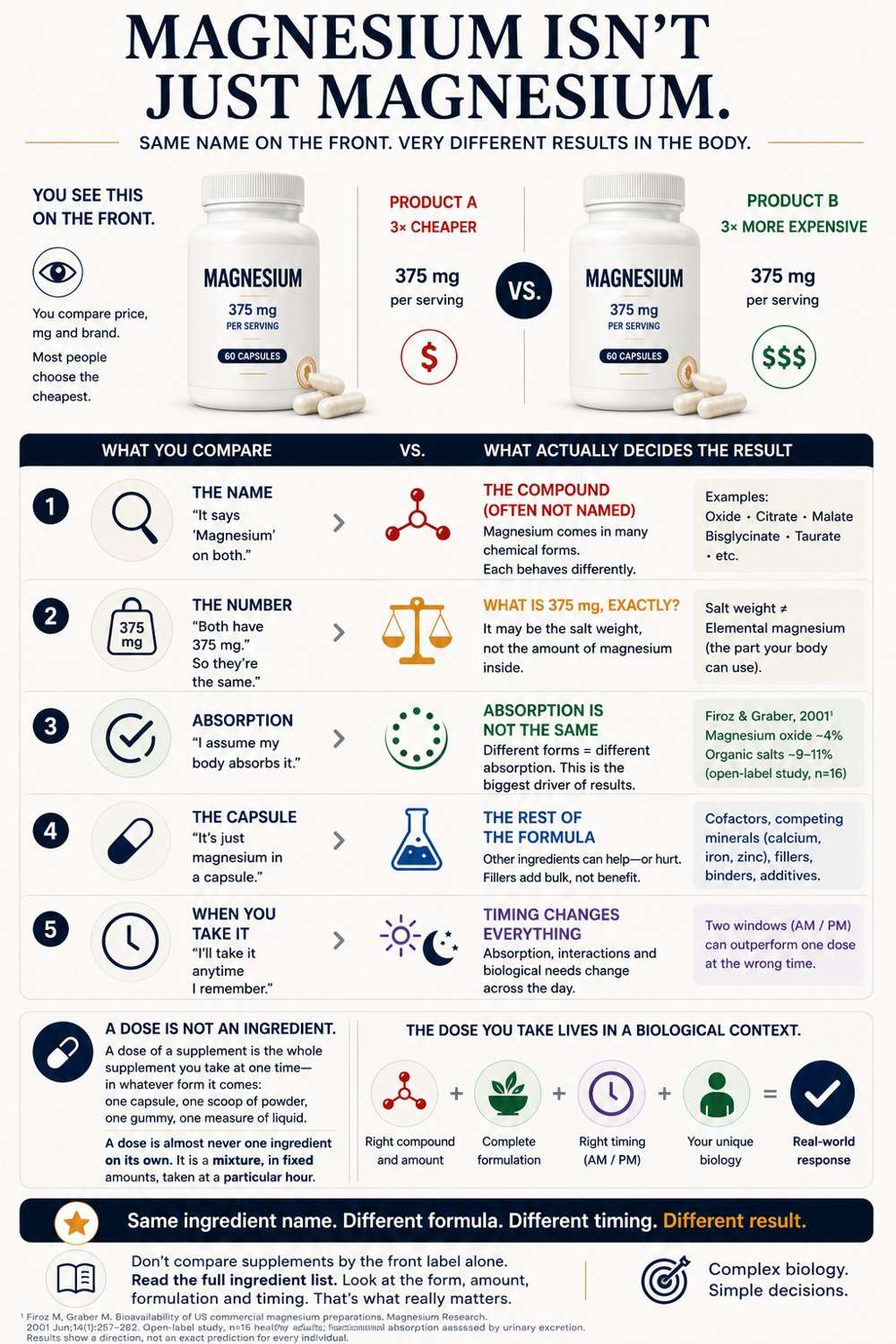
Magnesium isn't just magnesium. Five things separate two packs that carry the same word and the same number. Which compound the magnesium is bound to — often not named on the label at all. Whether 375 mg is the weight of the compound or of the magnesium inside it. How much is absorbed: Firoz and Graber measured roughly 4% for magnesium oxide against 9–11% for the organic salts, about four times higher, in a small open-label crossover of sixteen adults. What else is in the capsule — a cofactor such as vitamin B6, or a filler, or a competing mineral. And when it is taken. Oxide is the cheapest form and carries the most magnesium per gram, which is exactly why it produces the biggest number on the front of the cheapest pack — and the least of it into the body.
So the cheaper pack can genuinely contain more magnesium by weight and still deliver less of it into the body. "Is it magnesium?" is the wrong question. "Which compound, how much of the actual mineral, with what, and when?" is the right one — and the front of the pack answers none of it.
And a dose is almost never one ingredient
This is the part that gets missed. A dose of a supplement is usually a mixture, and what an ingredient does depends on what arrives with it. That is not a marketing idea; it is ordinary absorption science, and it works in both directions.
- Some combinations help. Vitamin C restores vitamin E after it has been used, so several moderate antioxidants together can outperform one large one. Fat-soluble vitamins need fat present to be absorbed at all.
- Some combinations hurt. Calcium competes with magnesium for absorption. Iron, zinc and copper compete with each other for the same intestinal transport. Two minerals in the same capsule can each deliver less than either would alone.
Where the honest line sits: the interactions above are well documented. Broader claims that a blend is somehow greater than the sum of its parts usually are not — most "synergy" language in this industry is decoration. What is defensible is narrower and still decisive: an ingredient behaves differently depending on the compound it is bound to, the amount it arrives in, what it competes with, and the hour it arrives. All four of those belong to the dose, and none of them appear on an ingredient list.
Almost everyone compares supplements by reading the ingredient list and then the price, because that is what the pack puts in front of you. But an ingredient is only a name. What reaches your body is a dose of a supplement — a particular compound, in a particular amount, mixed with particular company, at a particular hour. Two products with identical ingredient lists can be entirely different products for that reason, which is why the ingredient count is the least useful number on the pack.
How the category is built
The all-in-one category has settled on a single format. AG1, IM8 and Longevity Complete are each one scoop, once daily, most commonly in the morning. Blueprint recommends its Longevity Mix in the morning, with food. IM8 states that even its two-product stack — Essentials Pro plus Daily Ultimate Longevity — is combined into a single daily morning ritual.
This is a real achievement. It replaces a shelf of bottles with one habit, and habit is where most supplement routines quietly die. For a great many people it is the right product.
But the single-serving format imposes three constraints that are structural rather than formulation problems. Better formulating does not remove them.
| Constraint | Why it cannot be formulated away |
|---|---|
| A serving has a fixed weight | A 12 g scoop is 12 g. Once vitamins, minerals, fibre, flavouring and acidity regulators have taken their share, the botanicals and specialty actives divide what remains. This is why the herb, mushroom and adaptogen complexes in the largest products sit well below the amounts used in the underlying research — IM8's digestive enzyme, adaptogen and mushroom complex is 200 mg in total, split across roughly a dozen named ingredients. That is arithmetic, not carelessness. |
| A serving has a fixed dose and a fixed hour | You cannot take three quarters of a scoop in any meaningful way, and you cannot remove one component of it. Everything arrives at the same hour, in the same gut, competing for the same transporters. Ingredients whose research was conducted in the evening are delivered in the morning alongside everything else. |
| A powder has to be made drinkable | A drink has to taste acceptable, so flavouring and sweetener are not optional; it has to stay in suspension, so gums and acidity regulators go in; and it has to be mixed, so it needs water, a scoop and a shaker before it can be taken at all. None of that is in the product for the buyer's benefit. It is the cost of the delivery form. |
Table 1. Three structural constraints of the single-serving format.
A scoop is one decision, made once, by the formulator. A capsule architecture is a set of decisions the person taking it can keep making — how much, which formula, and when.
02Whose day is the standard day?
The all-in-one format assumes a particular user: someone who wakes at the same hour every day, gets daylight in the morning and darkness in the evening, keeps the same schedule seven days a week, and has a physiology that does not change much from month to month. That is the standard day the single-serving format is built around.
Almost nobody lives it.
Almost everyone, because modern life pulls the clock apart
Start with the largest group, which is not a special case at all. Social jetlag — the gap between the hours your biology wants and the hours your schedule imposes — is the ordinary condition of working and studying life in industrialised countries. Roughly 70% of that population experiences at least an hour of it, and close to half experience two hours or more, every week, for the whole of a working career. It is a time-zone shift you never travel for and never recover from.
The light environment does the same thing from the other direction. Modern humans spend up to 93% of their time indoors, under artificial light that is bright enough to delay the clock in the evening and far too dim to anchor it in the morning. Screens after dark blur the difference between day and night; the mornings that used to reset the system now happen under a ceiling. The result is a weaker signal telling the body which hour it is — not in shift workers, in everyone.
The honest limit of this point matters. No supplement corrects a desynchronised clock. Light exposure does, consistent sleep and wake times do, and meal timing does — and all three are free. What a phase-timed system can do is more modest: not add to the confusion. If the day is already sending mixed signals about what time it is, a supplement that arrives at the same hour regardless is one more input with nothing to say about it.
Perimenopause and the menopausal transition
Oestrogen receptors sit on dermal fibroblasts, so when oestrogen begins to fluctuate and then decline, collagen synthesis becomes less efficient while breakdown accelerates. The consequence is well documented: skin collagen can fall by as much as 30% in the first five years after menopause, followed by roughly 2% a year thereafter — a far steeper curve than the 1–1.5% annual decline of ordinary ageing. Evening settling and sleep architecture also change during the transition, and they change at the opposite end of the day from where a morning scoop is delivered.
What is legally supportable here is narrow and specific. Vitamin B6 contributes to the regulation of hormonal activity. Vitamin C contributes to normal collagen formation for the normal function of skin. Zinc and biotin contribute to the maintenance of normal skin. Magnesium and B6 contribute to normal psychological function and to the reduction of tiredness and fatigue. Nothing here treats menopause, and any product claiming to should be treated with suspicion.
The format argument is this: a woman in transition does not have one need, she has a daytime need and an evening need, and they are different needs. She may also want the structural layer at a higher intake for a period of months while leaving the others unchanged — which a four-formula system allows and a single scoop does not.
High training load and physical performance
Magnesium requirement rises with training volume and magnesium is lost in sweat. Magnesium contributes to normal muscle function, to electrolyte balance, and to normal energy-yielding metabolism — three authorised claims that all point at the same population. Of the all-in-one products here, only Longevity Complete publishes its elemental magnesium: 56.4 mg per serving. AG1, IM8 and Blueprint do not disclose theirs. The two magnesium formulas in the system described later supply 250 mg between them at the standard intake.
More to the point, adaptation and repair happen during sleep, not during training. The evening phase is the one that matters most to an athlete, and it is precisely the phase a morning-only product cannot reach. Someone in a heavy training block can move the magnesium phase to two capsules and leave the rest at one; in a recovery week they can move it back. A scoop offers no equivalent.
Shift and night work
This is where the single-serving format breaks down completely, and it is not a small population: EU data indicate roughly 21% of the workforce on shift schedules and around 19% doing night work, with rotating shifts the most common arrangement.
Every all-in-one product on this page is dosed "in the morning." For a nurse who wakes at 16:00, or a driver on a rotating roster whose schedule moves every week, "morning" is not a time on a clock. It is the first hours after waking, and it moves. A product built around one fixed serving taken at one fixed hour has no way to follow that. Its instruction becomes wrong the moment the schedule rotates.
A phase architecture is defined relative to the person rather than to the clock: the AM window is the first hours after waking, and the PM window is the hours before sleep, whenever those fall. When the roster changes, the protocol changes with it — nothing about the product has to be reinterpreted. This is not a marketing distinction. It is the difference between an instruction that can be followed and one that cannot.
And people who have already done the hard part
The last group is the opposite of a problem case. If you already sleep seven or eight hours at consistent times, eat well, train, get daylight in the morning and have people around you, then you have captured most of the effect available to anyone — the entire base of the pyramid in section 03. That is a real achievement and it is worth more than everything a supplement can add.
It also puts you in an unusual position: the large levers are already pulled, and what is left is the small remainder. This is the person for whom timing is worth thinking about, precisely because the obvious things are already handled. It is also the person most likely to be sold something exotic and expensive from the top of the pyramid, on the grounds that the basics are covered. Timing is cheaper than that, better evidenced than that, and available before any of it.
None of these is an edge case, and the first one is most of the population. Each describes someone whose biology is not the same at both ends of the day, or whose day does not begin when the clock says morning, or who has already taken the free wins and is looking at what is left. The single-serving format is not badly designed for them — it simply has no mechanism to accommodate them.
03What a supplement can realistically do
Before comparing any of these products it is worth being honest about the size of the prize, because the honest answer is smaller than the category implies and it changes how the rest of this article should be read.
There is no single percentage, and anyone quoting one is inventing it
You will sometimes see a figure — supplements are five percent of the picture, or ten. No such number exists in the literature, because the question is not answerable that way: the effect depends entirely on whether the person taking the supplement had a gap to fill. What does exist are effect sizes, and they all point in the same direction.
The base is enormous
Li and colleagues, in Circulation in 2018, followed roughly 123,000 people for up to 34 years and measured what five low-risk lifestyle factors are worth: never smoking, a healthy body mass index, at least thirty minutes a day of moderate to vigorous activity, moderate alcohol intake, and a high-quality diet. People with all five had a projected life expectancy at age 50 that was 14.0 years longer for women and 12.2 years longer for men than people with none, and were 74% less likely to die during follow-up.
five low-risk lifestyle factors
five low-risk lifestyle factors
n ≈ 123,000, up to 34 years
No supplement has ever produced a result remotely comparable, and none is likely to. That is not a criticism of supplements. It is the correct scale on which to place them.
The supplement evidence in well-nourished people is small or null
In 2022 the US Preventive Services Task Force reviewed the randomised evidence on vitamin and mineral supplementation for preventing cardiovascular disease and cancer in community-dwelling adults. It recommended against beta carotene and against vitamin E. For multivitamins, and for single or paired nutrients generally, it concluded the evidence was insufficient to determine whether benefits outweigh harms. The supporting evidence review found little or no benefit for preventing cancer, cardiovascular disease or death, with a small benefit for cancer incidence with multivitamins.
That is the honest state of the field, and a supplement brand that does not tell you so is hoping you will not look.
Which is why many people feel nothing — and why that is not a scandal
Those trials studied supplementation in people who were mostly not deficient. Where there is a real gap, filling it does something. Where there is no gap, filling it cannot. The reason many people take a supplement and feel nothing is not that the product is fraudulent — it is that in a well-nourished person without a deficiency, the expected effect is small enough to sit below the threshold of subjective perception. Anyone promising you will feel a supplement is making a promise the evidence does not support.
The pyramid, in order of size of effect
| Tier | What it is | Size of effect | Cost |
|---|---|---|---|
| Base | Sleep, food, movement, social connection, daylight exposure, not smoking, alcohol | Largest by orders of magnitude — measured in years of life | Free, and hard |
| Second | Rhythm and timing — when you sleep, eat, move and see light | Substantial; circadian misalignment is an independent risk factor for metabolic, cardiovascular and cognitive disease | Free, and behavioural |
| Third | Repletion of genuine gaps — magnesium, vitamin D at northern latitudes, B12 on a plant-based diet, folate in pregnancy | Real where the gap is real. Nothing where it is not | Low |
| Fourth | Cofactor and signal support — most of what is in this article | A small addition. Worth having, not worth overstating | Moderate |
| Top | Experimental longevity compounds — NAD precursors, spermidine, senolytics | Smallest evidence base. Mostly short trials measuring blood markers rather than what happens to people | Highest |
Table 2. The order matters more than any individual row. Effect size falls as you move up; cost and novelty rise.
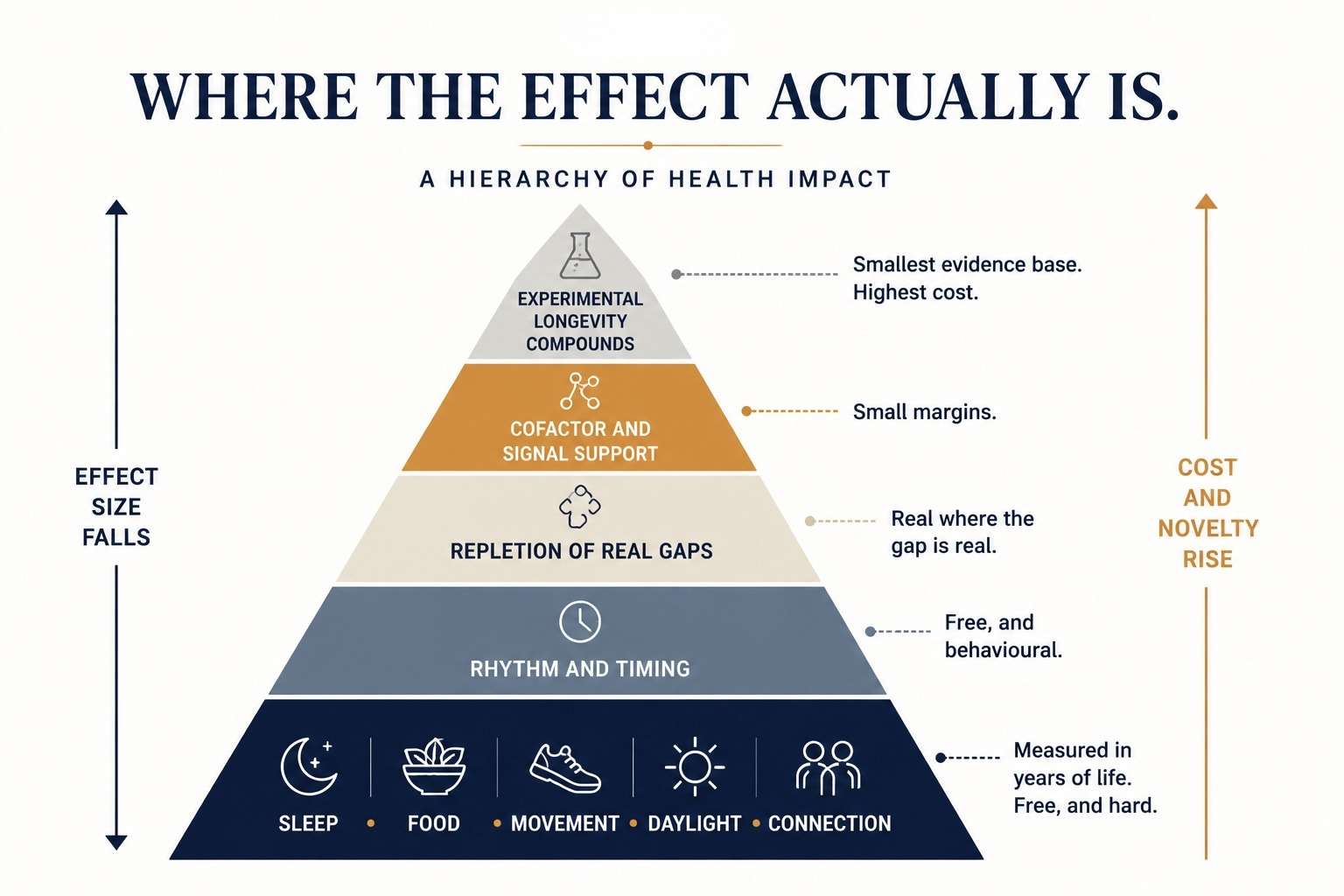
Where the effect actually is. The order of the tiers matters more than any single row. Effect size falls as you move up; cost and novelty rise. Everything sold as longevity sits in the top two bands, which is where the margins and the marketing budgets are — and where the evidence is thinnest. The base is free, difficult, and worth more than everything above it combined. Read the amber band honestly: that is where this product sits, and it is a small band by design rather than by modesty.
The mistake the longevity market is built on
No trial of an NAD precursor, spermidine or any comparable compound has shown that it compensates for insufficient sleep or for inactivity. None has tested that, and it would be a strange thing to expect. These molecules are studied in people whose foundations are assumed to be in place — which means the top of the pyramid only does whatever it does once the base beneath it exists.
Buying the top while the base is unbuilt is the most common and most expensive error in this category, and the market is structured to encourage it: the top tier is where the margins, the novelty and the marketing budgets are. Nobody sells you sleep.
This is not a contrarian position and it should not be presented as one. Longevity Complete states on its own product page that no supplement can substitute for sleep, nutrition, exercise and mental wellbeing. That is correct, and it is the minimum honest standard rather than a distinguishing virtue. The question worth asking of any product is not whether the brand says this, but whether the product is designed as though it were true.
What follows for a product, if you take this seriously
If the amount a supplement can add is genuinely small, the only rational response is to refuse to waste any part of it. That is a design brief, and it is a demanding one:
- Do not duplicate what the person already takes, or already gets from food.
- Do not exceed the intake limits, where exceeding them adds nothing and can subtract.
- Do not deliver an ingredient in the phase of day where it works against the biology it is aimed at.
- Do not pay for ingredients present in amounts too small to do anything.
- Do not let the supplement stand in for the base — say plainly that it does not.
A supplement does not produce the result. Sleep, food, movement and the people around you produce it — a supplement can only improve it at the edges. What a well-designed one does is avoid wasting that small improvement: no overlapping, no exceeding the limits, nothing arriving in the wrong part of the day, and no asking you to believe it is doing more than it is. That is the whole offer. It is worth making precisely because the amount at stake is small, which is what makes it worth not wasting.
04Simple, safe, sustainable — and why decluttering is a clinical argument
If the honest gain from supplementation is small, two things follow that most of this category ignores. The routine has to be one a person can actually hold for years. And the totals have to be safe, because the only reliable way to turn a small benefit into a real harm is to take too much of something without noticing.
A protocol you abandon delivers nothing
The base of the pyramid works only when maintained for decades, and the same is true one tier up. A supplement routine abandoned in week six delivers nothing at all, whatever is in it. So the design constraint is not the maximum number of ingredients that will fit — it is the maximum adherence a real life will tolerate.
That is a demanding brief, and it is the opposite of the one most of this industry works to. It means: as few moments in the day as the biology permits, and no fewer. No equipment. No preparation. Nothing that fails when you travel, work a night shift, or are simply tired. A routine that survives the bad weeks is worth more than a better formula that does not.
Longevity has become cognitively expensive
The problem in this field is no longer a shortage of information. It is the opposite. Ten bottles on a shelf, two or three protocols half-followed, a wearable producing numbers nobody interprets, a panel of biomarkers, a new compound every quarter, and confident contradictory advice from people who have never met you. Every one of those arrives as an addition. None of them removes anything.
That has a price which never appears on a price list: the number of decisions you have to make, and keep making, every day. Decisions are what fails first — earlier than motivation, earlier than belief, and much earlier than the biology. A protocol nobody can sustain is not a sophisticated protocol. It is an unfinished one.
Which is why timing is usually misunderstood
Adding a schedule to a supplement sounds like one more thing to manage — another rule, another way to get it wrong. It is the opposite, but only if the schedule is built into the product rather than handed to the buyer.
When the formulator decides that taurate belongs in the evening and succinate in the morning, the person taking it never has to know what a counterion is. When a formula is designed for a phase, the instruction becomes "when you wake" instead of "read the label and work it out." The complexity does not disappear. It moves — from the person taking the supplement to the person designing it. That is what it means to say complexity belongs in the formulation and not in the routine, and it is the only version of that phrase worth anything.
Judged that way, a timed system is not an additional layer of sophistication laid on top of an already crowded shelf. It is the mechanism by which the shelf gets shorter: decisions made once, at the point of design, instead of every morning by someone who is tired.
The best protocol is not the one with the most interventions. It is the one sophisticated enough to respect the biology, and simple enough to still be followed on a bad week. Sophistication that cannot be sustained is not sophistication — it is an expense.
How people actually take supplements
It is worth being accurate about the behaviour this has to survive, because the industry writes instructions for a person who does not exist — someone who takes the product at the same hour every day without being reminded.
The best available measurements come from electronic monitoring, where a chip in the cap records every time the container is opened. Across 76 such studies, Claxton and colleagues found that people took the prescribed number of doses about 71% of the time. But when the same studies looked at whether the doses were taken within the prescribed time window, compliance fell to 59%. That is prescribed medication, in monitored clinical studies, with a physician involved. Roughly four times in ten, the pill was taken at the wrong time or not at all.
electronically monitored
Claxton et al. 2001
the cliff is at three and four
A supplement has none of those supports. Nobody prescribed it, no pharmacist explained it, nobody follows up, and the packet usually says only "one daily" — which in practice means whenever the bottle is noticed. The honest picture of supplement-taking is not a morning ritual. It is an irregular event, often skipped, often at a different hour each time.
The objection this raises, and the honest answer
If adherence is the problem, does asking for two moments a day rather than one make it worse? It is the right question, and the data are more reassuring than they first look. In the same review, dose-taking compliance was 79% for once-daily regimens and 69% for twice-daily — but that difference was not statistically significant. The significant falls came at three doses a day (65%) and four (51%).
So the cliff is not between one and two. It is between two and many. A shelf of thirty products is not a once-daily routine at all; it is a large number of separate decisions taken every morning, which is precisely the arrangement the evidence says collapses.
The second half of the answer is that "twice a day" is a worse instruction than "when you wake and before you sleep", even though they describe the same thing. The first is a frequency and has no anchor, so it defaults to whenever the bottle is noticed. The second attaches the behaviour to two events that already happen every day without being remembered. That is not a marketing preference — it is the reason the protocol is written as two windows rather than as a number of doses.
Safety is a design constraint, not a disclaimer at the bottom of the page
Supplements are not automatically benign, and the evidence on this is not ambiguous. The same USPSTF review that found little benefit for most supplementation recommended against beta carotene specifically because of harm — increased lung cancer incidence in people who smoke. More is not better once a requirement is met, and past the upper limit more is worse.
Several nutrients in any system like this sit close enough to their limits that the total across all products matters more than the amount in any one of them:
| Nutrient | EU / national reference | Why the total is what matters |
|---|---|---|
| Magnesium | 250 mg/day from supplements (EFSA guidance) | This figure is set on gut tolerance — the point at which supplemental magnesium starts to cause loose stools — rather than on toxicity. It is also a per-day figure that behaves differently when the amount is split, because the effect depends on how much arrives at once. Taking a second magnesium product alongside is how people exceed it without noticing. |
| Vitamin B6 | Upper level 12 mg; German BfR has issued warnings | B6 appears in three of the four formulas here. Individually trivial, cumulatively worth counting — and it appears in most multivitamins and greens powders too. |
| Zinc | Upper level 25 mg | Sustained high zinc intake induces copper deficiency by competing for the same transport. Zinc and copper have to be considered as a ratio, not as two separate numbers. |
| Beta carotene | Recommended against for CVD/cancer prevention | The clearest available demonstration that a supplement can do harm rather than nothing. |
Table 3. Where the total across products matters more than the amount in any one product.
This is the part of the decluttering argument that is not about aesthetics. If you take a multivitamin, a greens powder, a magnesium, a B-complex and a separate zinc, nobody is adding up the totals — not you, and certainly not five manufacturers who do not know about each other. A closed system can count. Five open bottles cannot. Fewer bottles is an arithmetic position before it is a lifestyle one.
Not fewer ingredients — fewer bottles, fewer overlapping decisions, and totals somebody is counting. A routine simple enough to hold for years, safe enough to repeat indefinitely, and aimed at the few targets with the largest footprint. That is the whole design, and it is a clinical position rather than a stylistic one.
05The option missing from every comparison: your own shelf
Every comparison in this category pits one branded product against another, which quietly misrepresents the actual choice. For most people the real alternative is neither a powder nor a system. It is the shelf they already own — built one bottle at a time, over years, each purchase a reasonable response to one article, one symptom or one recommendation.
That is how almost every large supplement collection in Europe came to exist. Owning thirty separate products is common. Fifty is not unusual, and the people who own fifty are usually the most motivated and best-informed buyers in the market — which is the point. The stack is not what careless people end up with. It is what careful people end up with, because buying one ingredient at a time is sensible at every single step and unreasonable once you add it all up.
| Measure | A self-built stack | One all-in-one serving | Four timed formulas |
|---|---|---|---|
| Containers to buy, store and track | 30 | 1 | 4 |
| Purchase and reorder decisions | 30 products, 30 expiry dates, 30 quality judgements | 1 | 1 to 4 |
| Who adds up the totals | Nobody — thirty manufacturers who do not know about each other | The manufacturer, within one product | The manufacturer, across the whole system |
| Overlap and duplication | Invisible, and near-certain at thirty items | None internally, but unavoidable if you add anything | Designed out; each nutrient has one home |
| Timing control | Theoretically total; in practice everything gets taken at once, because that is the only way to remember | None — one serving, one hour | Two windows, by design |
| Freedom to choose form and dose | Complete — the real advantage of the stack | None | Within the formulas |
| Cost per milligram | Lowest, if you buy well | Moderate | Moderate |
| How much gets abandoned | High — half-used bottles, expired stock, abandoned routines | Low | Low |
Table 4. The same thirty ingredients, arranged three ways. The ingredients are not the variable. The arrangement is.
What actually goes wrong with a self-built stack
- Nobody counts the totals. Thirty manufacturers do not know about each other, and neither does the person swallowing the result. Vitamin B6 is in the magnesium, in the B-complex, in the multivitamin and in the greens powder. Individually trivial; cumulatively worth counting, and nobody is.
- Interactions go unmanaged. Zinc against copper, calcium against iron and magnesium — these are not exotic. They are the first thing a clinician checks and the last thing a shelf accounts for.
- Timing collapses to one moment. A stack owner has complete theoretical control over when each thing is taken, and almost none in practice, because remembering thirty items twice a day is not a routine anyone sustains. So everything goes down at once, usually in the morning — the same failure as the scoop, arrived at from the opposite direction.
- It costs more, not less. The cost per milligram can be low while the total is high: thirty products bought separately, each with its own margin and its own postage, comes to more per month than a system of four. And you have to hold stock of all thirty, because they run out at different times.
- It becomes a source of stress rather than relief. A stack starts as enthusiasm and turns into an obligation. Something is always finished, always on order, always missing — and once one item is missing, it is easy to feel the rest is not worth taking either. That all-or-nothing feeling is how stacks quietly end.
- The decision load is the hidden cost. Thirty products means thirty repurchase decisions, thirty expiry dates, thirty quality judgements and thirty opportunities to be sold something you did not need. That load, not the capsules, is what people are actually tired of.
Not a competitor's product. A shelf. The thirty ingredients are not the problem — the thirty decisions are.
What is deliberately not in the system — and should be bought separately
A system that claims to contain everything cannot tell you what to add, and is therefore not decluttering anything; it is just a bigger bottle. Four things are left out of this one on purpose, and each for a reason worth stating:
| Left out | Why | What to do instead |
|---|---|---|
| Vitamin D3 (with K2) | The right amount is individual and cannot be fixed in advance — latitude, season, skin tone, body weight and baseline blood level all change it. A single fixed amount inside a system is the wrong design for a nutrient that should be titrated. | Buy separately and, ideally, dose against a measured blood level rather than a guess. |
| Omega-3 (EPA/DHA) | A gram-scale oil. It cannot be delivered meaningfully in a capsule system without an unreasonable capsule count, and oxidation and freshness matter enough that it deserves its own dedicated product and its own storage. | Buy separately, from a source that publishes an oxidation value. |
| Creatine | Three to five grams a day. Powder is simply the correct format, and no capsule architecture can compete with a scoop here. | Buy separately as monohydrate powder. |
| Active B-complex | Vitamin B6 is already present across the formulas here. Adding a full active B-complex on top is precisely the invisible overlap this system exists to remove — and a full B-complex is for specific situations, not a default. | Add only for a specific reason — a plant-based diet, a known B12 issue, a relevant genotype — and count the B6 when you do. |
Table 5. Deliberate exclusions. Anything beyond these should follow an individual need or a test result, not a trend.
Naming what a product does not contain is part of the same argument as naming what it does. Declutter does not mean buy everything from one brand. It means own fewer decisions. A short list of things to add deliberately is a smaller decision load than thirty products chosen one at a time — and it is the only honest form the claim can take.
06What each product actually is
| Measure | EscapeMed 30D | Longevity Complete | AG1 | IM8 Essentials Pro | Blueprint Longevity Mix | Self-built stack |
|---|---|---|---|---|---|---|
| Format | 4 capsule formulas | Powder, 1 scoop | Powder, 1 scoop (12 g) | Powder, 1 scoop (12 g) | Powder, 1 scoop | A handful of separate products |
| Daily windows | 2 — morning and evening | 1 | 1 | 1 | 1 | 1 in practice — everything at once |
| Timing | AM phase and PM phase | Once daily, preferably morning | Once daily, typically morning | One daily morning ritual | Recommended in the morning, with food | Total in theory; one moment in practice |
| Dose adjustable by user | Yes — 1 or 2 capsules per formula; formulas can be taken singly | No — fixed scoop | No — fixed scoop | No — fixed scoop | No — fixed scoop | Yes — completely; the stack's real advantage |
| Evening formula in base system | Yes | No | Sold separately (AGZ) | No | No | Only if you buy and remember one |
| Total actives | 30 | 24 | 75+ | 90+ | 11 named | 30, chosen by you |
| Magnesium forms | 8, sorted into two phases | 2 (malate, taurate) | Not disclosed | Glycinate | 1 (citrate) | Whatever you bought |
| All per-ingredient amounts published | Yes | Yes | No — proprietary blends | Partly — several complexes given as one total | Yes | Varies by product |
| Added sugar | None | None | None | None | None stated | Varies |
| Flavouring / sweetener | None — none needed | Mango-pineapple flavour | Flavour + stevia | Açaí-berry flavour | Blood-orange flavour | Varies |
| Needs water, shaker or mixing | No | Yes — 250–500 ml | Yes — 8–12 oz | Yes — 8–12 oz | Yes | No |
| Has a taste | No | Mango-pineapple | Earthy, divides opinion | Açaí-berry | Blood orange | Varies |
| Travel | Bottle or pill case; nothing else needed | Pouch + scoop + shaker, or paid sachets | Pouch + scoop + shaker, or paid travel packs | Pouch + scoop + shaker, or paid sachets | Pouch + scoop + shaker | Several bottles, or decanting into a pill organiser |
| Dose accuracy | Fixed per capsule | Scoop; manufacturer notes settling may occur | Scoop | Scoop | Scoop | Fixed per capsule, per product |
| Daily intake | 4 capsules (Basic) or 8 (Intensive) | 1 scoop | 1 scoop | 1 scoop | 1 scoop | Commonly 15–40 capsules |
| Manufactured | GMP-certified, Slovenia (EU) | IFS-certified, Netherlands (EU) | Not stated on EU page | Not stated | Not stated | Varies by product |
| EU availability | EU (Slovenia) | EU (Netherlands) | EU entity (Ireland) | Ships to EU from outside | Ships to EU via a forwarding partner | Varies |
| Vegan / non-GMO / allergen-free | Yes | Vegan, non-GMO, gluten-free | Vegan, gluten-free; contains soy | Vegan, gluten-free | Vegan, keto-friendly | Varies |
Table 6. Structural comparison from published product pages, August 2026.
The comparison that actually matters: depth inside a domain
Total ingredient count is the number every brand in this category leads with, and it is the least informative one available. Thirty against ninety looks decisive until you ask the only question that affects a buyer: how many of those ingredients are working on the thing I came here for?
| Biological domain | EscapeMed 30D | Longevity Complete | Blueprint Longevity Mix | AG1 / IM8 |
|---|---|---|---|---|
| Magnesium forms | 8, phase-sorted | 2 (malate, taurate) | 1 (citrate) | Not disclosed |
| Elemental magnesium per day | 250 mg (Basic) to 500 mg (Intensive) | 56.4 mg | Not disclosed | Not disclosed |
| Skin and connective-tissue actives | 14 | 5–6 | 4 (glutathione, hyaluronate, vitamin C, lysine) | Named, amounts inside proprietary blends |
| Evening and night actives | 8 | 0 — single morning serving | 0 — recommended in the morning | 0 in the base product; AG1 sells AGZ separately |
| Standardised plant extracts | 8, incl. KSM-66 ashwagandha, astaxanthin, Polypodium, chamomile | Lion's mane, quercetin | None named | Named, amounts inside proprietary blends |
| Mitochondrial / energy-phase actives | 5, incl. malate and succinate as TCA substrates | Creatine, NR | Creatine, calcium AKG | Not disclosed |
| Evening-studied actives delivered in the morning | None — they are in the evening formulas | Glycine 2,000 mg | Glycine, L-theanine, taurine | Not disclosed |
| Total actives | 30 | 24 | 11 named | 75+ / 90+ |
Table 7. Counts for EscapeMed, Longevity Complete and Blueprint are taken from their published ingredient lists. AG1 and IM8 name their ingredients but place the amounts inside proprietary blends, so a domain count for them cannot be verified — which is itself the finding.
Read the evening rows together. None of the four comparison products has anything working after 18:00 in its base formula — not because the formulators forgot the evening, but because a single morning serving structurally cannot address it.
The row beneath it is the more interesting one, and it is not our observation — it is theirs. Longevity Complete places 2,000 mg of glycine in a morning serving. Blueprint places glycine, L-theanine and taurine in a mix its own product page recommends taking in the morning, with food. Those are ingredients whose human research was largely conducted in the evening. This is not a claim that they cause harm at breakfast; the amounts and the evidence do not support that. It is the observation that when a format has only one window, everything goes in it — including the things that were studied in the other one.
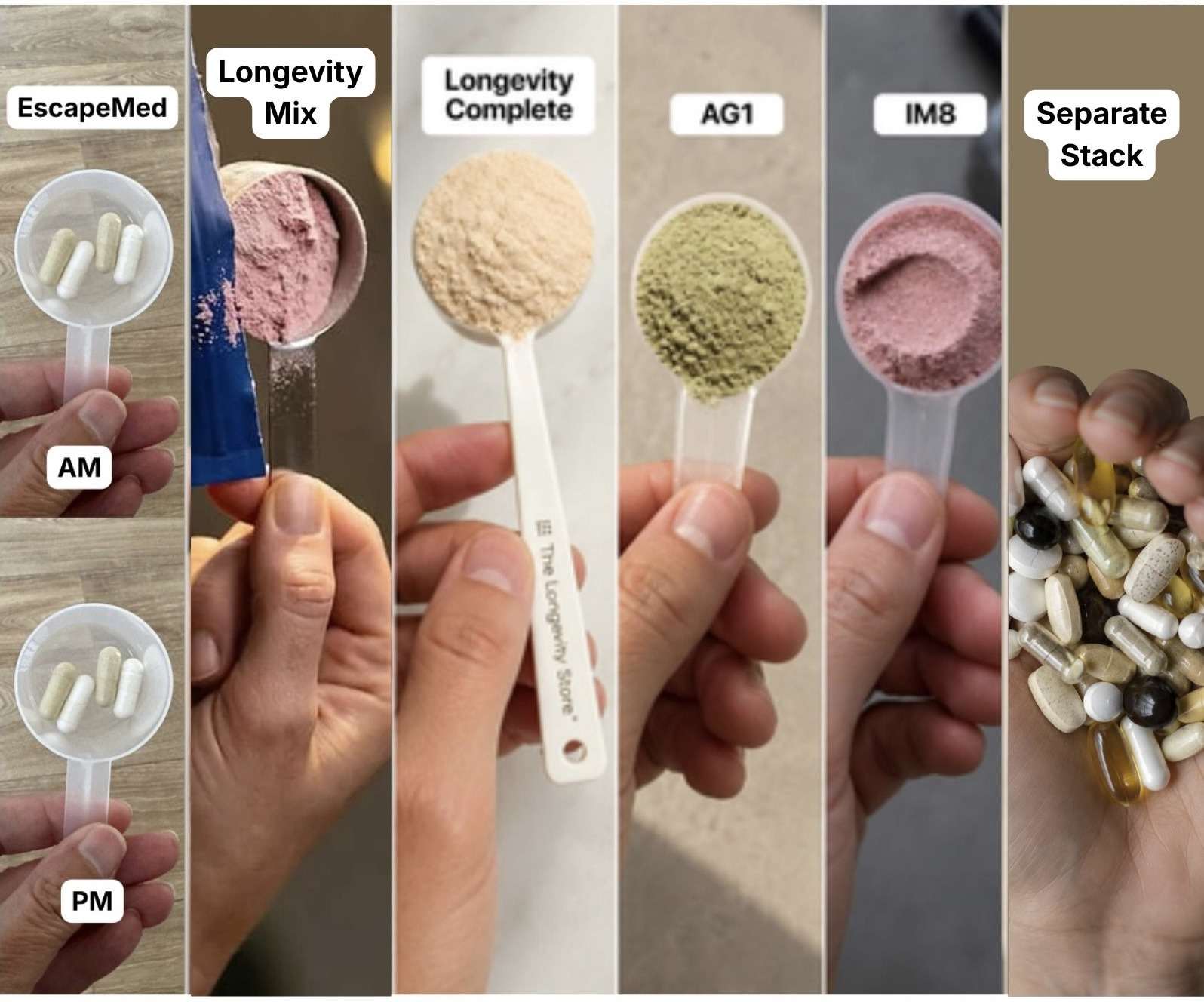
One day of each arrangement, in the same measuring scoop. Six ways to take a day's supplements. Four of them are a single serving swallowed once, in the morning, at one fixed amount for everyone. One is a handful of separate products taken together, which is the arrangement most people actually own. Only the first is two — a morning window and an evening one — with every capsule a decision that can be taken or left. The ingredients differ far less between these panels than the arrangements do.
07Thirty ingredients, five biological systems
Ingredient counts are a poor unit of measurement because they say nothing about what the ingredients are for. A more useful question is how many distinct biological systems a formulation actually addresses, and whether it addresses each one at the point in the day when that system is active.
The count of thirty is arrived at by listing every distinct active once across the whole system: eight magnesium forms — bisglycinate, citrate, malate, succinate, ascorbate, taurate, gluconate and lactate — plus twenty-two others. Each form is counted once rather than once per bottle.
The thirty actives are organised as five biological systems. The systems cut across the four formulas rather than mapping one-to-one onto them — magnesium appears in three formulas, vitamin B6 in three, cellular protection is concentrated in one. A system is a biological function, not a bottle.
| System | Why it is high leverage | Where it lives | Principal actives |
|---|---|---|---|
| 01 Muscle, neuromuscular function and recovery | Muscle is the largest organ by mass and holds roughly 27% of the body's magnesium — second only to bone. Every ATPase-dependent reaction requires a magnesium–ATP complex, and magnesium is the physiological counterweight to calcium in both contraction and relaxation. Relaxation is the half most people forget. | Magnesium AM + Magnesium PM + Super Sleep | Eight magnesium forms — bisglycinate, malate, citrate, L-ascorbate, succinate (AM); bisglycinate, taurate, citrate, lactate, gluconate (PM); vitamin B6. Authorised: normal muscle function, electrolyte balance |
| 02 Mitochondrial energy production | Where ATP is actually made, and the system that declines most visibly with age. ATP is biologically inactive unless bound to magnesium. | Magnesium AM | Malate and succinate as citric-acid-cycle substrates, citrate, myo-inositol, CoQ10, vitamin B6. Authorised: normal energy-yielding metabolism |
| 03 Connective tissue, skin, hair and nails | Collagen is roughly 30% of total body protein. Skin is the largest organ, and the same protein forms the matrix of bone, tendon, blood vessels, fascia and every organ capsule. It declines with age and steeply through the menopausal transition. | Skin Renewal Complex | Vitamin C, zinc, copper, biotin, MSM, hyaluronic acid, ceramides, choline. Authorised: normal collagen formation for skin; normal skin, hair and nails |
| 04 The antioxidant network | Not a single molecule but a recycling system: vitamin C regenerates vitamin E, glutathione regenerates vitamin C, and CoQ10 sits inside the same loop. This is the one place where several moderate amounts genuinely work better than one large one. | Skin Renewal Complex | Glutathione, N-acetylcysteine, astaxanthin, vitamin E, vitamin C, CoQ10, Polypodium leucotomos, zinc, copper. Authorised: protection of cells from oxidative stress |
| 05 Nervous system and sleep | The foundation everything else runs through, and the only tier-one behaviour a supplement can sit alongside rather than substitute for. | Super Sleep + Magnesium PM | Glycine, L-theanine, L-tryptophan, ashwagandha KSM-66, chamomile, magnesium bisglycinate, vitamin B6, melatonin at a physiological signal amount. Authorised: normal psychological and nervous system function |
Table 8. Five systems across four formulas. Authorised EU health claims are listed at the end of this article; ingredients without one are named and quantified without an associated benefit claim, as EU law requires.
The reason this matters for the comparison is that systems 01 to 04 have a daytime component and system 05 is entirely evening biology. A single morning serving delivers whatever it has for all five at 07:00. Most of it lands in roughly the right place. The evening layer does not — which is the subject of the next paragraph.
Recovery is the half of the argument that gets left out
Training is only the stimulus. The adaptation — protein synthesis, tissue repair, glycogen restoration, autonomic recovery — happens afterwards, and overwhelmingly during the evening and during sleep. That is why an athlete who trains well and recovers badly plateaus, and why recovery is the harder half to get right.
Which makes the timing question sharper here than anywhere else in this article. A morning-only product delivers its entire contribution roughly fourteen hours before the window where adaptation actually occurs. A phase-split system puts the evening magnesium forms and the night formula exactly there — not because it is a tidier story, but because that is when the body is doing the work.
And what is not a target here — said plainly
- Joints and cartilage. MSM is present at 500 mg but the joint literature uses gram amounts, and there is no collagen substrate in this system at all. If joints are your reason for buying, this is the wrong product and a collagen peptide is the right one.
- Bone. Magnesium, zinc and copper contribute to the maintenance of normal bones, and bone holds most of the body's magnesium — but the principal levers are vitamin D and K2, and neither is here. Treat bone as incidental cover, not as a reason to buy.
- Immunity and gut. Vitamin C, zinc and copper carry authorised immune claims and are present, but immunity was not a design target and there is nothing here aimed at the microbiome. Both are side effects of the formulation rather than its purpose.
08Format: what a capsule does that a scoop cannot
Delivery form is usually treated as a matter of preference. It is not. It decides what has to go into the product, how accurate each dose is, and whether the routine survives contact with real life.
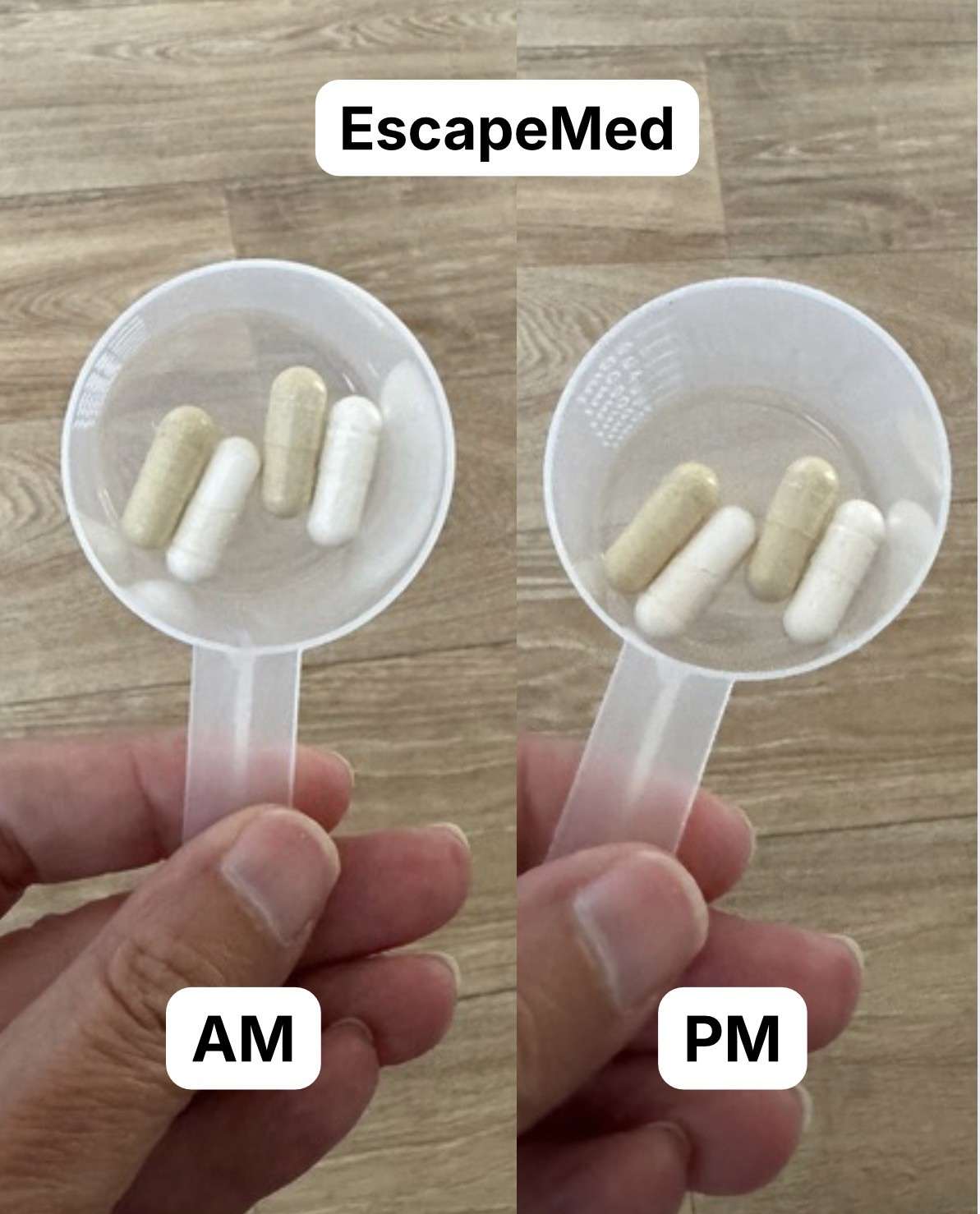
The EscapeMed day, in the same scoop. The same measuring scoop the category uses for powder, holding capsules instead. Two windows rather than one serving — no water beyond a glass, no shaker, no mixing, no taste, and every capsule a separate decision that can be taken or not taken. Shown at the eight-capsule Intensive protocol; the Basic protocol is half of this.
Five things the capsule format wins outright
- No taste, so no taste to tolerate. A powder has to be drunk, which means it has to be palatable, which is why every product here carries a flavour. Reviews of greens powders return persistently to an earthy taste and aftertaste, and manufacturers themselves note that whether you like it varies from person to person. A capsule is swallowed in two seconds and tastes of nothing. For anyone who does not enjoy drinking a flavoured supplement — a large group, and one the category tends to ignore — this is not a small detail. It is the whole difference between taking it and quietly stopping.
- No flavouring, sweetener, sugar, gum or acidity regulator. Those ingredients exist to make powder drinkable. They are not there for you. A capsule needs none of them, so the label contains actives and very little else, with no flavour system to account for at all.
- No water, no shaker, no scoop, no washing up. Every powder here requires 250–500 ml of liquid and something to mix it in. A capsule requires nothing. That is the difference between a supplement you can take at a desk, in a car, in a clinic, or at 22:00 without going to the kitchen — and one you can only take where there is water and a clean shaker.
- Travel. A pouch, a scoop and a shaker do not travel well; the alternative is buying single-serve sachets at extra cost. A capsule bottle or a pill case goes in hand luggage and works in a hotel room, on a flight, at a conference, on a night shift. This is the most common reason people abandon a powder, and it has nothing to do with the formula.
- An exact dose, every time. A capsule is filled and verified to a fixed amount. A scoop is a volume measure of a blended powder, and blended powders settle — one manufacturer here tells buyers on its own product page that natural settling occurs and to stir again before use. A packed scoop and a loose scoop are not the same dose.
Powder is the right form for gram-scale ingredients. For everything measured in milligrams — which is most of what matters in these products — the capsule delivers it more accurately, more portably, and without needing anything added to make it drinkable.
Where the all-in-one products are genuinely better
Any comparison written by a manufacturer that finds no merit in its competitors is an advertisement. These are real advantages and we are not going to pretend otherwise.
- More named ingredients in one serving. Seventy-five to ninety named ingredients touch more nutritional ground than thirty. If your diet has gaps you have not identified and you want the widest possible net, a broad-spectrum powder casts one. The caveat is that where a formula uses proprietary blends — several ingredients grouped under one combined weight, so the individual amounts stay hidden — how much of each named ingredient you actually receive is not disclosed, so breadth of names and breadth of effect are not the same measurement.
- Gram-scale ingredients. Creatine at 3 g, glycine at 2 g, dietary fibre, greens. Powder is the correct delivery form for these and the capsule format cannot match it without an unreasonable capsule count.
- One moment instead of two. Adherence decides whether any supplement does anything at all, and one daily moment is simpler than two.
- Company-funded clinical work on the finished product. AG1 and IM8 have funded human trials on their finished formulas. No controlled trial of the complete EscapeMed system exists; the published pilot work is single-arm and open-label — everyone took the product, nobody took a dummy, and everyone knew which they were taking — so it can raise questions but cannot answer them.
- Swallowing. A minority of people cannot or will not swallow capsules. For them a drink is the only workable format, and no argument above changes that.
09Modularity: what a fixed serving cannot do
Adjusting the dose
This is the difference most comparison articles miss entirely, because it does not appear anywhere on a label.
Every formula in a capsule architecture can be taken at one capsule or two. Every formula can be taken on its own, without the others. That produces a range of positions a single scoop cannot occupy, and the person taking it chooses the position — not the formulator.
| Situation | Capsule architecture | Fixed single serving |
|---|---|---|
| Sensitive to a new supplement; want to start low | Begin at one capsule, increase later | Full serving from day one, or nothing |
| Only want support in one area | Buy and take one formula | Whole formula or nothing |
| Higher personal requirement for one nutrient | Move that formula to two capsules; leave the others at one | Not possible without doubling everything |
| Already taking something separately; want to avoid duplication | Omit the overlapping formula | Duplication is unavoidable |
| Seasonal or cyclical change in need | Adjust up or down without changing product | Fixed year-round |
| Tolerance issue with one ingredient | Drop the formula containing it | Discontinue the whole product |
Table 9. Dose flexibility is a property of the format, not of any particular formula.
This is why the EscapeMed formulation papers document every ingredient at both the one-capsule and the two-capsule level rather than at a single "serving" figure. There is no single serving. There is a range, and a person somewhere inside it.
In practice this is sold as two named protocols at the same cost per capsule, so moving between them costs nothing in value — you pay for capsules, not for a serving size someone else chose:
One of each formula
250 mg elemental magnesium, split across the two windows. One box lasts 60 days. Cost per capsule identical in both protocols.
Two of each formula
500 mg elemental magnesium, split across the two windows. One box lasts 30 days. Cost per capsule identical in both protocols.
Table 10. The same four formulas at two intake levels. Follow the recommended daily intake stated on the label.
One figure is worth stating plainly rather than leaving in a footnote. The EFSA guidance level for magnesium from supplements is 250 mg a day — the Basic protocol sits at it, and the Intensive protocol is double it. That guidance figure is based on gut tolerance rather than toxicity: above it, supplemental magnesium begins to cause loose stools in some people. It is also sensitive to how the amount arrives, which is the practical reason a higher intake is split across two moments rather than taken at once. Anyone using the Intensive protocol is above the guidance figure and should know that; start at Basic, and go up only if you have a reason to.
No scoop can do this. A powder has one serving size, and the only way to take less is to guess with a partial scoop — which, in a blended powder that settles, is not a smaller version of the same dose. A capsule taken or not taken is exact either way.
A scoop gives everybody the same amount at the same time. That is its entire value proposition, and also its entire limitation.
Buying part of the system
A powder offers exactly one purchase decision: buy it, or do not. There is no smaller version, no partial entry, no way to address one problem without also buying the answer to nine others. The formula is fixed by construction — it is one product in one bag, and the bag is what you have to buy.
Four separate formulas can be sliced two different ways, which is a property of the architecture rather than a marketing choice.
| Slice | What you take | What you get |
|---|---|---|
| By window — Morning Duo | Magnesium AM + Skin Renewal Complex | The complete morning window: daytime magnesium forms, connective-tissue cofactors and the cellular protection layer |
| By window — Sleep Duo | Magnesium PM + Super Sleep | The complete evening window: evening magnesium forms and the non-sedative night formula |
| By layer — Magnesium Duo | Magnesium AM + Magnesium PM | One biological layer across both ends of the day: eight magnesium forms, phase-sorted |
| Whole system | All four formulas | Five biological layers across two windows |
Table 11. The same four formulas, entered at four different sizes. When combining formulas the magnesium total is the figure to watch — follow the recommended daily intake stated on the label.
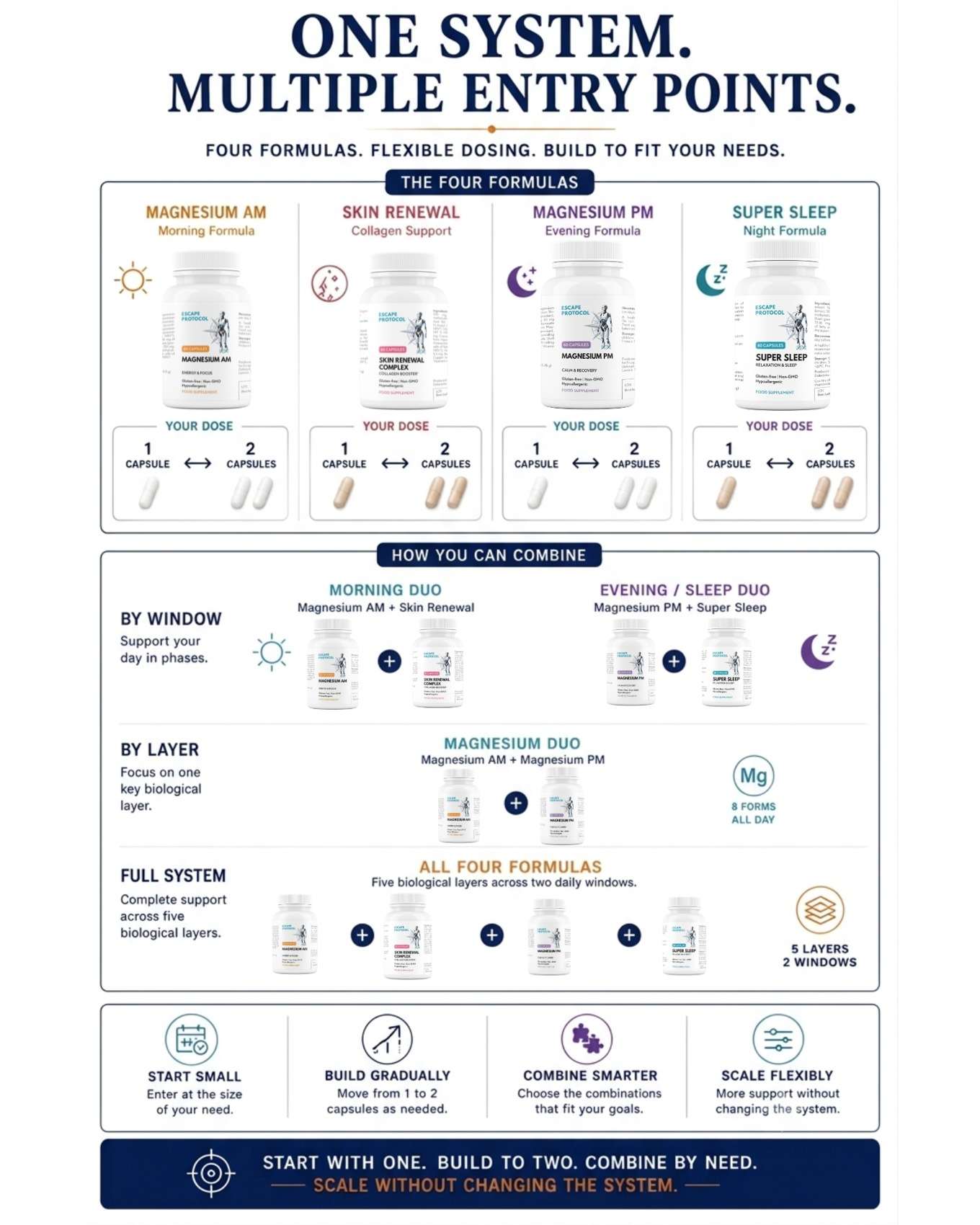
One system, multiple entry points. Every formula can be taken at one capsule or two, and every formula can be bought on its own. That produces the two slicing axes described above: by window, taking both formulas for one end of the day; or by layer, taking one biological system across both ends. The same four products therefore have four entry sizes rather than one, and moving between them changes the coverage without changing the brand, the formulas or the routine. A single serving offers exactly one of these positions, to everyone, permanently.
Four reasons this matters, none of which a single-serving product can answer:
- You can enter at the size of the problem. Someone whose only complaint is a restless evening buys the evening window. They do not have to buy ninety ingredients to get the eight that are relevant to them.
- You do not pay for overlap. If you already take a vitamin D or an omega-3 you are happy with, nothing here duplicates it. With a single fixed product you buy the entire list every month whether or not half of it repeats what is already in the cupboard — and that duplication is precisely the clutter worth removing.
- You can scale up without switching product. Start with one duo, add the other when you want the full day. The brand, the formulas and the routine never change; only the coverage does.
- A month that does not work costs one formula, not the whole system. If one formula does not suit you, you drop that formula. With a single serving the only available response is to stop taking everything.
A bundle is more decisions at the checkout than "add to cart." A single fixed product is simpler to buy. A modular system is simpler to live with — fewer bottles you do not need, less overlap, and a routine you can change without changing brand. That is the trade, and it is worth stating plainly rather than pretending it does not exist.
10Two windows, not one: the timing argument
Worth stating precisely, because this argument is easy to overstate and frequently is.
What is well established
Circadian rhythm governs digestion, hormone secretion, thermoregulation and cellular repair, and the timing of nutrient intake influences absorption and bioavailability — particularly for fat-soluble vitamins, minerals and antioxidants. This is the field of chrononutrition and it now carries a substantial review literature. That when can matter is not controversial.
What follows concretely
Minerals compete for the same transport
Iron, zinc and copper share intestinal transport. Calcium interferes with both magnesium and iron. Spacing mineral doses is routine clinical practice for exactly this reason — which means a single serving containing every mineral at once delivers less than the label arithmetic implies. A morning and evening split is the simplest available correction.
The research often specifies an hour, not just an amount
The human trials on glycine and sleep — Inagawa 2006, Yamadera 2007, Bannai 2012 — each administered approximately 3 g before bedtime, with a proposed mechanism involving core body temperature falling ahead of sleep onset. Longevity Complete contains 2,000 mg of glycine, close to that studied amount, taken in the morning. The evening formula in the EscapeMed system contains 167 mg per capsule — roughly a twentieth of the studied amount, in the studied window.
Neither product reproduces the trial conditions. We are pointing at a design question, not claiming a trial result.
Some ingredients have an obvious wrong window
Calming amino acids and adaptogens formulated for evening use are not improved by a 7 a.m. delivery. A full day's magnesium in one morning dose is a different physiological event from the same total split across morning and evening.
Why a magnesium salt is not just a delivery vehicle
The exclusions described below rest on a specific piece of chemistry: the counterion — the second molecule that magnesium is bound to, which is what makes bisglycinate different from taurate — is biologically active in its own right. Taurine acts at GABA-A and glycine receptors. Malate and succinate are intermediates of the citric acid cycle. So a magnesium taurate capsule and a magnesium malate capsule deliver the same mineral and two different second molecules, with opposite implications for the phase of day they belong in. That is the mechanistic basis for excluding taurate from a morning formula and succinate from an evening one.
The part a single serving cannot do: leaving things out
Everything above is about adding the right thing at the right hour. The sharper version of the argument is the opposite one — deliberately withholding an ingredient from the phase where it does not belong.
In this system the eight magnesium forms are sorted accordingly, and the sorting includes explicit exclusions:
| Form | Morning formula | Evening formula |
|---|---|---|
| Taurate | Deliberately excluded — taurine has a calming action, wrong for the morning | Included |
| Malate and succinate | Included — TCA cycle substrates, mitochondrial phase | Deliberately excluded — mitochondrial stimulation counteracts evening biology |
| Bisglycinate | Included | Included |
| Citrate | Included | Included |
| L-ascorbate | Included | — |
| Lactate, gluconate | — | Included |
Table 12. Eight magnesium forms, sorted by phase. The exclusions are the design, not an omission.
This is the one thing a single serving structurally cannot do. A scoop has to contain everything it contains, all at once — so it can add an ingredient to the day, but it can never withhold one from a phase. A formulation split across two phases can. Adding an ingredient is open to every brand. Keeping one out of a phase is not.
Anyone can put an ingredient in. Only a formula split across phases can decide where it does not go.
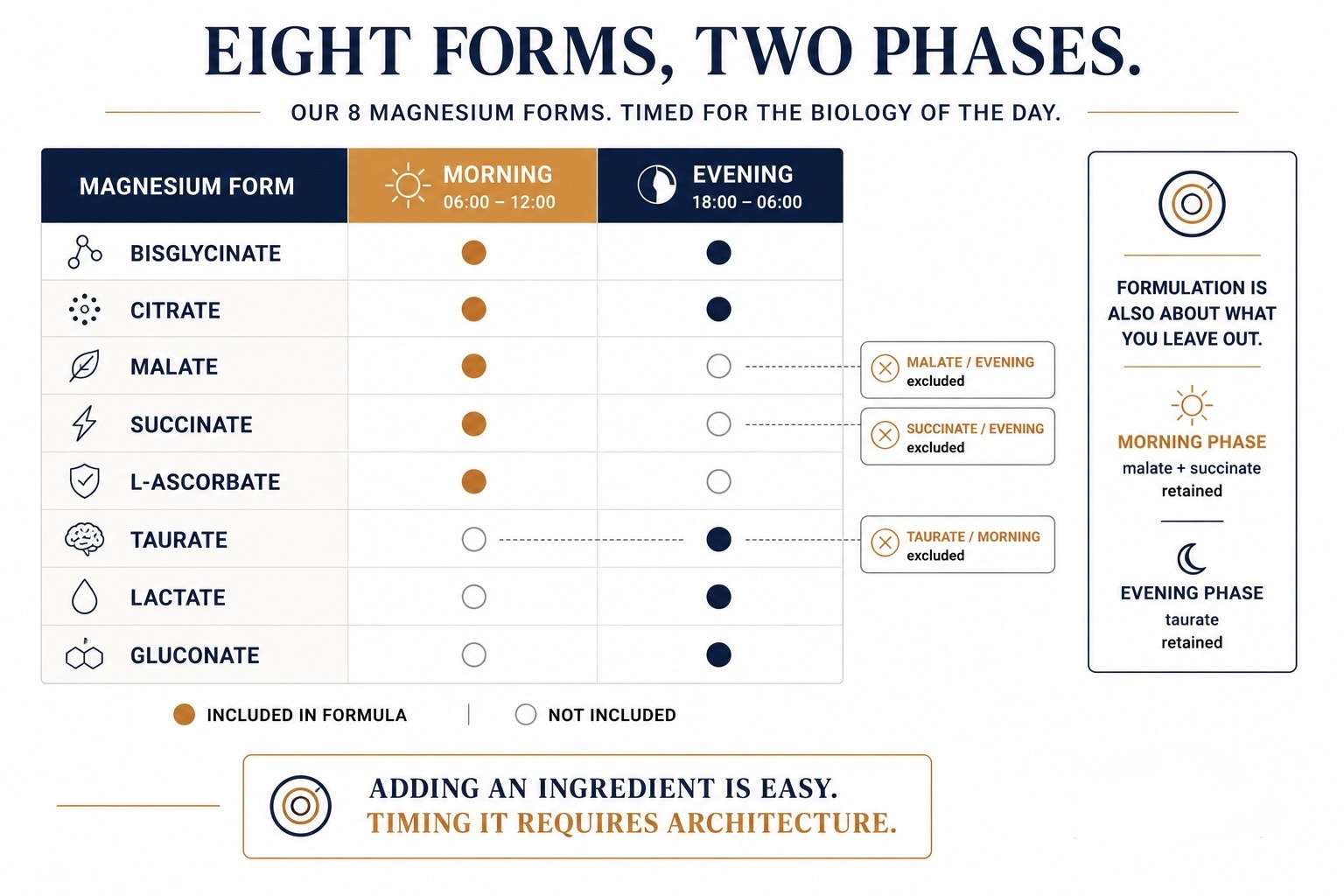
Eight forms, two phases. The filled circles are the formulation; the open circles are the decisions. Taurate is withheld from the morning because the taurine it carries has a calming action that works against the morning phase. Malate and succinate are withheld from the evening because they are citric-acid-cycle substrates and stimulate the system the evening is meant to wind down. A single serving cannot do this. It has to contain everything it contains, all at once — so it can add an ingredient to a day, but it can never keep one out of a phase.
Four formulas, two windows
A common misreading of a phase-based system is that it demands four separate alarms. It does not. The four formulas are phase-specific in their design, but the practical routine is two moments in the day: an AM phase and a PM phase. Two, against one for a scoop — not four.
| Window | When | What |
|---|---|---|
| Window one | Morning | Magnesium AM and Skin Renewal Complex. Daytime magnesium forms, cofactors for connective tissue, and the cellular antioxidant layer, positioned in the earlier part of the day. |
| Window two | Evening | Magnesium PM and Super Sleep. Evening magnesium forms and the non-sedative night formula, positioned ahead of the sleep window. |
Table 13. Four formulas, two dosing moments.
What we are not claiming
- No head-to-head trial against any product on this page has been conducted, by us or anyone else.
- We are not claiming that a timed system produces better outcomes than a powder. Nobody has demonstrated that.
- We are claiming that dose flexibility and timing are design variables the single-serving format cannot express — and that this is a reason to think about format before comparing ingredient counts.
11Timing in practice: what happens when it goes wrong
Everything above is the design argument. This chapter is the practical one — what each formula is actually timed for, how strong each of those reasons is, and what it costs when the timing is ignored, which for most people it is.
So what actually happens if you take it at the wrong time?
This is the question the exclusions invite, and the honest answer has three different levels depending on what you got wrong. It is worth separating them, because the industry tends to collapse all three into a single vague warning.
Where the consequence is real and measurable: the mineral total
Magnesium absorption is saturable — meaning the gut can only take up so much at a time, and the more arrives at once, the smaller the share that gets through. The effect is large. Fine and colleagues, in the Journal of Clinical Investigation in 1991, measured net absorption across a wide range of intakes and found fractional absorption falling from 65% at the lowest intake to 11% at the highest. The intestine takes up a shrinking share of what arrives as the amount rises.
Fine et al., JCI 1991
same study, same method
Firoz & Graber 2001, n = 16
So taking both magnesium formulas together — morning and evening at the same moment — delivers a larger single load to the gut and absorbs a smaller proportion of it. The remainder stays in the bowel and draws water into it, which is the mechanism behind the loose stools people associate with magnesium. Splitting a day's magnesium across two moments is not a marketing device. It is how you absorb more of it and tolerate it better, and it is the clearest consequence of ignoring the phase.
Note what this has nothing to do with: the counterion. This consequence would follow from splitting any magnesium salt, and it is the single most practically useful thing in this section.
Where it is real but modest: melatonin in the morning
Melatonin's effect on the body clock is phase-dependent. Taken in the evening it tends to advance the clock; taken in the morning it tends to delay it. A night formula containing melatonin, swallowed at breakfast, therefore pushes the clock in the direction you did not want — later rather than earlier. At a physiological amount the push is small, and one morning will not undo anything. Done habitually, it is working against the thing it was included for.
And where the honest answer is: probably nothing you would notice
If you take magnesium taurate in the morning, you will most likely feel no different. Taurine acts at GABA-A and glycine receptors and the direction of its effect is calming — but the amount carried into a capsule as a magnesium counterion is not a sedative dose, and no trial has shown that morning taurate impairs anything. The same applies in reverse to malate and succinate at night: they are citric-acid-cycle intermediates, and these amounts are small against normal metabolic flux. Nobody has demonstrated a next-day consequence in either direction, and we are not going to claim one.
Which makes the exclusions a design standard rather than a warning. If a formulation is going to be split by phase at all, the split should follow the biology instead of being arbitrary — and where a counterion has a known direction of effect, it belongs in the phase that matches it. That is a claim about coherent design, not about harm. Anyone telling you that the wrong magnesium salt at the wrong hour will ruin your evening is overselling a real principle, and overselling is how real principles get discredited.
If you take everything at once, the thing it actually costs you is magnesium absorption and gut tolerance — not the counterion. Split the magnesium and keep the melatonin at night. Everything beyond that is optimisation rather than repair.
What each formula is timed for — and how good the reason is
The exclusions above are one half of the argument. The other half is why each formula sits where it does. These four reasons are not equally strong, and it is worth saying which is which rather than presenting them as a uniform wall of rationale.
| Formula | When | The reasoning | How strong the reason is |
|---|---|---|---|
| Magnesium AM | The first hours after waking | Malate and succinate are citric-acid-cycle intermediates, placed in the active phase; the ascorbate salt carries vitamin C with it. | Moderate. Mechanistic and coherent, but no trial has compared morning against evening for these salt forms. |
| Skin Renewal Complex | Morning, alongside Magnesium AM | Collagen synthesis is under circadian control rather than running at a constant rate, so the cofactors it depends on are placed in a fixed daily window rather than at a random hour. Grouping it with the morning formula also keeps the routine to two moments instead of three. | Weakest of the four. The rhythm of collagen production is established; the optimal human hour is not, and nobody has tested morning against evening for these cofactors. Reasoned, not demonstrated. |
| Magnesium PM | Evening | Taurate's counterion acts at GABA-A and glycine receptors, so it sits in the phase that matches it — and this is the second half of a split dose. | Two different strengths. The split itself is measurable (absorption). The counterion placement is mechanistic only. |
| Super Sleep | 30–60 minutes before sleep | Melatonin's effect on the body clock is phase-dependent: evening tends to advance it, morning tends to delay it. | Strongest of the four. The direction of the phase response is established, and this is the one formula where the wrong hour works against the intended effect. |
Three of the four reasons are mechanistic rather than demonstrated. Saying so is not a weakness in the design; concealing it would be.
What actually goes wrong in real life
The failure worth designing against is not someone carefully swapping the morning and evening formulas. Almost nobody does that, and if they did, the honest expectation is that they would notice nothing — the counterion amounts are too small for a next-day consequence in either direction.
The real default is simpler and far more common. One magnesium. One bottle. Taken at whatever hour the bottle happens to be noticed, alongside whatever else is in the cupboard. That is what the adherence data describes and it is what most people reading this actually do. Three things go wrong at once in that arrangement, and only one of them is timing.
| What goes wrong | In the random single dose | Why it costs something |
|---|---|---|
| Dose | The whole day's magnesium arrives in one load | Absorption is saturable. Fractional uptake falls from 65% at low intakes to 11% at high ones, and the unabsorbed remainder stays in the bowel and draws water into it. The same amount in two halves is absorbed better and tolerated better. |
| Timing | One formula, one hour, chosen by whichever is remembered | Half the day is uncovered whichever half you pick, and a single formula carries the counterion suited to only one end of the day. |
| Combination | Swallowed with a multivitamin, a calcium, an iron, or whatever else is due | Calcium competes with magnesium for absorption, and iron, zinc and copper compete with each other. Magnesium also arrives without the vitamin B6 it is routinely paired with in clinical formulations. What arrives alongside a mineral changes how much of it is taken up. |
Table 14. The realistic failure is not one large error. It is three moderate ones happening simultaneously.
This is what the dose–timing–combination figure means in practice. None of these three losses is dramatic on its own — that is exactly why they go unnoticed, and exactly why they compound. A person doing all three is not taking a smaller dose of magnesium. They are taking a dose that is absorbed less completely, arrives in only one phase, and competes for uptake with whatever it was swallowed beside. The label still says 250 mg.
And the one error nobody actually makes
For completeness rather than for warning: melatonin taken after waking pushes the body clock later rather than earlier, which is the opposite of the reason it is in an evening formula. It is the only timing decision in this system with an established direction behind it — and it is also the one nobody gets wrong, because a night formula taken at breakfast is an obvious mistake in a way that a randomly timed magnesium is not.
Three of the four timing rationales here are mechanistic rather than demonstrated, and this article is not going to pretend otherwise. What is measurable is the arrangement: split the mineral, keep the night formula at night, and do not swallow it alongside the things that compete with it. Coherent design is worth having. It is not the same as proof.
12What the biology actually supports — and what it does not
The timing argument is only worth making if the underlying biology is real. It is, but not uniformly, and the honest version of this chapter distinguishes what is established from what is inference. A reader who wants to argue with this system deserves to know exactly where the weak joints are.
Every tissue keeps its own time
The suprachiasmatic nucleus — a small cluster of cells in the brain that keeps the body's master clock — is not the only clock you have. Nearly every tissue in the body carries a cell-autonomous molecular oscillator built from the same transcriptional feedback loop — CLOCK and BMAL1 driving PER and CRY, which then suppress their own drivers on a roughly 24-hour cycle. Liver, skin, gut, muscle and immune cells all run one. This is why "timing" is not a metaphor about lifestyle. It is a description of what is happening inside the cells the ingredient is aimed at.
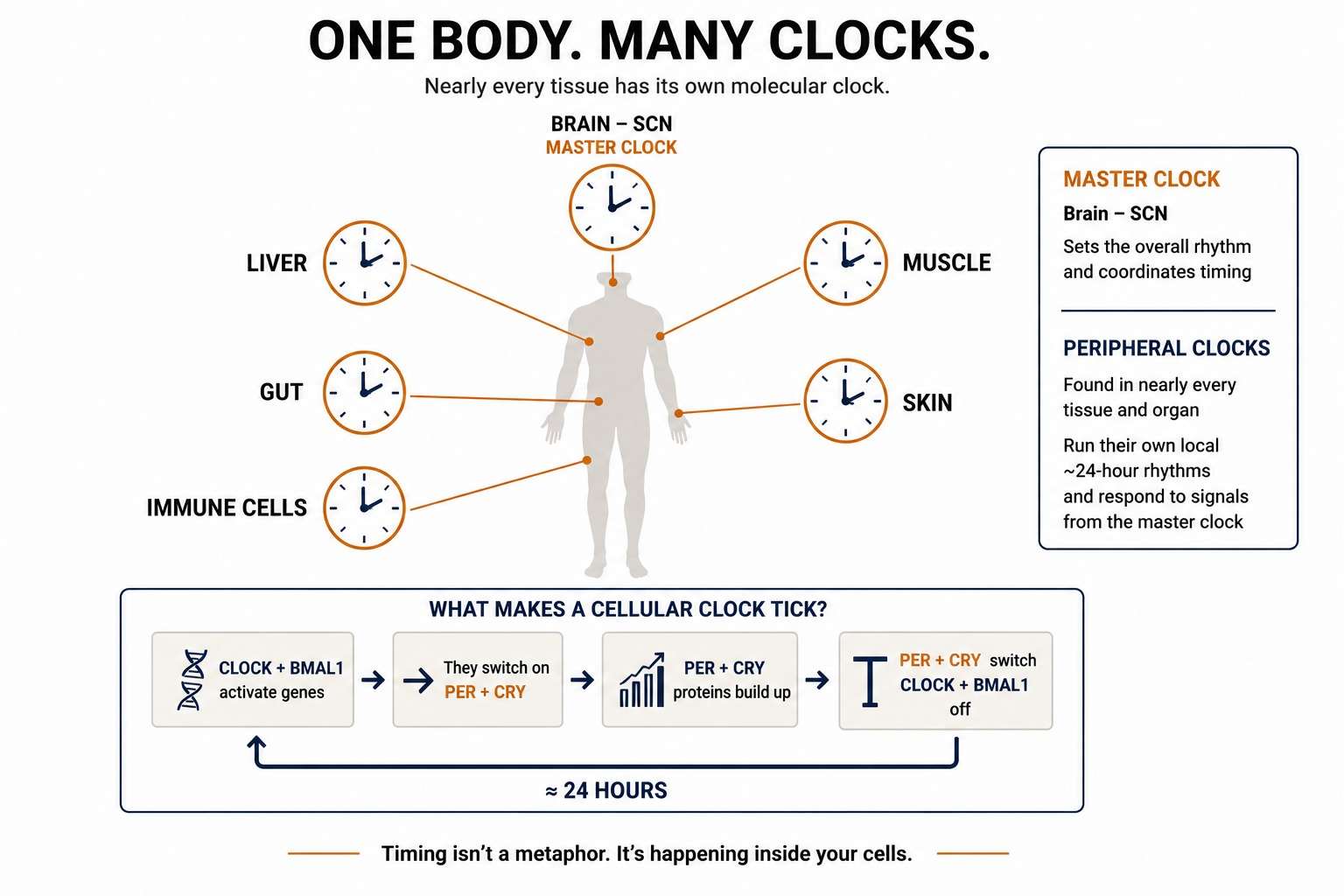
One body, many clocks. The suprachiasmatic nucleus sets the overall rhythm, but nearly every tissue in the body carries its own cell-autonomous clock and runs its own local 24-hour cycle. Each is built from the same transcriptional feedback loop: CLOCK and BMAL1 switch on PER and CRY, the PER and CRY proteins accumulate, and once they do they switch CLOCK and BMAL1 back off — a self-limiting cycle that takes roughly 24 hours to complete and then begins again. Because the loop runs inside the cell rather than being imposed on it from outside, the liver, muscle, gut, skin and immune cells are each keeping time independently. This is why timing is not a lifestyle concept. It is a description of what is happening inside the cells an ingredient is aimed at.
Collagen production is rhythmic, not constant
This is the strongest single mechanism behind putting a connective-tissue formula in one window rather than spreading it across the day. Chang and colleagues, publishing in Nature Cell Biology in 2020, showed that procollagen transport from the endoplasmic reticulum to the cell membrane is under direct circadian control, through the sequential rhythmic expression of SEC61, TANGO1, PDE4D and VPS33B. Clock-synchronised fibroblasts secrete procollagen rhythmically. Disabling the clock produced abnormal collagen fibrils and collagen accumulation.
The honest caveat matters as much as the finding. That work was done in mouse tendon, and mice are nocturnal — their active phase is our rest phase, so the clock hour does not transfer directly to humans. What transfers is the principle: collagen synthesis is clock-gated rather than continuous, and human collagen turnover markers show a clear diurnal rhythm. What is not settled is the precise optimal human hour. Anyone telling you otherwise is ahead of the evidence.
Medicine already doses by the clock
The most useful thing to know about supplement timing is that the question is not new and not ours. Timing is already a routine clinical variable, written into the instructions on medicines millions of people take every day — and it is there because it changes what the drug does.
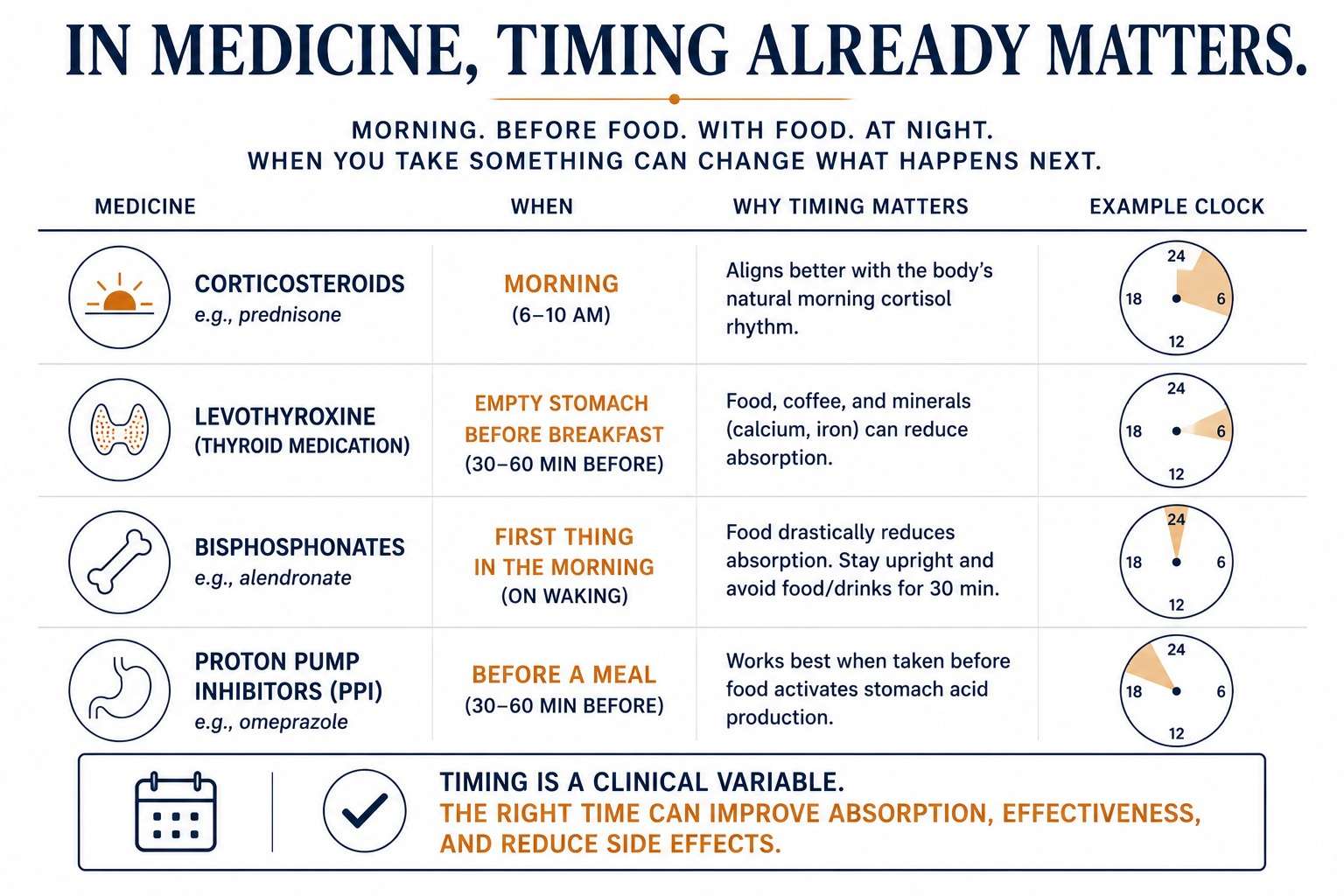
In medicine, timing already matters. Four everyday examples. Corticosteroids are given in the morning to sit with the body's own cortisol rhythm. Levothyroxine is taken on an empty stomach because food, coffee, calcium and iron reduce how much of it is absorbed. Bisphosphonates are taken on waking, upright, well before food, for the same reason. Proton pump inhibitors work best taken before a meal, because they act on acid pumps that food activates. Two of these are about the body's clock and two are about the state of the gut — but in all four, the hour is part of the prescription rather than a detail left to the patient.
The distinction is worth drawing precisely, because it is where most writing on this subject becomes sloppy. Corticosteroid timing is genuinely circadian — morning dosing mimics the endogenous cortisol peak and reduces adrenal suppression. The thyroid, bisphosphonate and acid-pump examples are about absorption and gut state rather than the body clock. They are not the same mechanism.
What they share is the thing that matters here: nobody in medicine treats the hour as arbitrary. It is specified, it is taught, and patients are told to follow it. The claim in this article is narrower than the clinical literature, not broader — if timing is a variable worth writing on a prescription, it is at least a variable worth designing a supplement around.
Where the circadian evidence is genuinely contested — the timing of antihypertensive medication is the clearest case, with earlier positive findings not reproduced in the TIME trial — the honest position is that the field is not uniform. The argument is about which molecules and how much, never about whether the hour exists.
No trial has compared this formulation, or any comparable formulation, given at two different times of day. That study does not exist for this system and it does not exist for any product in this comparison. The timing argument is mechanistic. It is a hypothesis about how a supplement should be designed, supported by established circadian biology and by clinical precedent in pharmacology — not a demonstrated outcome. Anyone who tells you their timed supplement is proven to work better is describing a study that has not been done.
13The dose question, answered directly
The most substantive criticism this system can receive is that some ingredients appear in amounts below those used in the studies that made them interesting. That criticism is partly correct. It deserves a direct answer rather than a defensive one, because the answer is more interesting than the objection.
Not every amount in a formula is doing the same kind of job. Three categories, and they are judged by different standards:
| Category | What it is for | How it should be judged |
|---|---|---|
| Repletion | Refilling a measurable shortfall. The amount has to be real or nothing happens. | Against the reference intake. Magnesium at 250 mg/day is 66.7% of the EU reference value — enough to carry every authorised magnesium claim. Vitamin C in the morning formula reaches 234%. These are full doses. |
| Cofactor-calibrated | Enzyme cofactors — helpers an enzyme needs in order to work, which are not used up in the process. Copper, biotin, zinc in the skin formula. | Against the enzyme's requirement, not against a gram-scale study. Copper at 0.25–0.5 mg is not a low dose of copper; it is a copper dose. Loading a cofactor does not speed the enzyme it serves, and it displaces the minerals it competes with. |
| Signal | Providing a physiological cue rather than a pharmacological effect. Melatonin, and the evening amino acids. | Against the endogenous concentration, not against a sedative dose. Nocturnal plasma melatonin is measured in picograms per millilitre; a 3–10 mg tablet overshoots that range by orders of magnitude. A 0.1–0.2 mg amount is designed to sit near it. |
Table 15. Three dose categories, three different standards of judgement. Conflating them is what produces the objection.
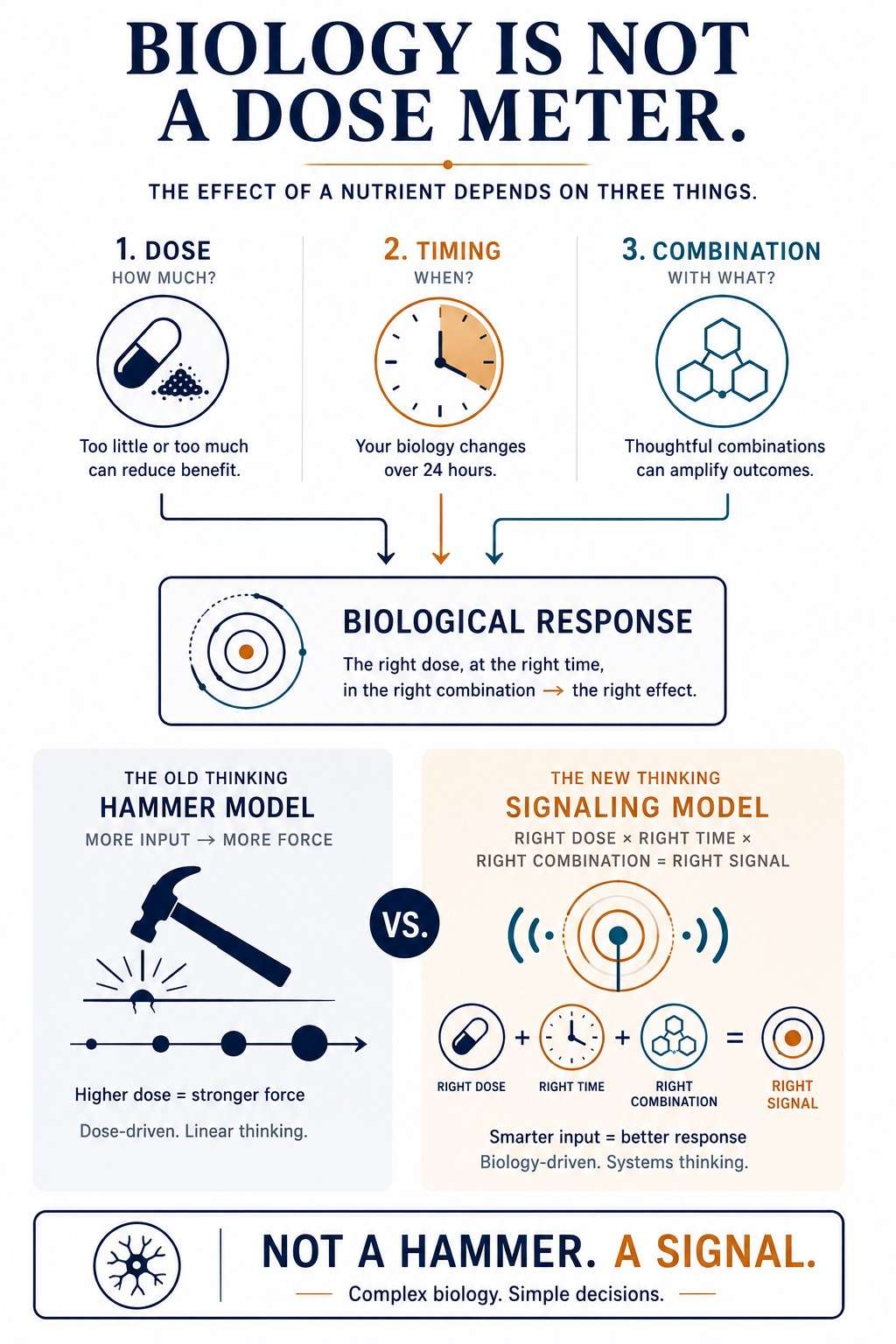
Biology is not a dose meter. The objection this chapter answers assumes a straight line: more input, more effect. Biology does not work that way, and the industry that sells on milligram counts depends on you believing it does. Three variables determine what an ingredient actually does — how much, at what hour, and alongside what else. Raising only the first while ignoring the other two is the hammer model, and it is why a large single dose of one antioxidant can underperform several moderate ones that regenerate each other. The signal model is not a softer claim. It is a more demanding one, because it has to get three things right instead of one.
Why a normal blood test does not settle the magnesium question
Worth knowing before anyone concludes they do not need any: serum holds well under 1% of total body magnesium — by some measures around 0.3% — while roughly 60% sits in bone and 27% in muscle, and the kidney defends the serum concentration by drawing on those stores. A serum result inside the reference range is therefore compatible with a depleted tissue pool, and work using magnetic resonance spectroscopy has found age and muscle function to track intracellular magnesium more closely than serum magnesium. This is also why repletion is measured in weeks to months rather than days.
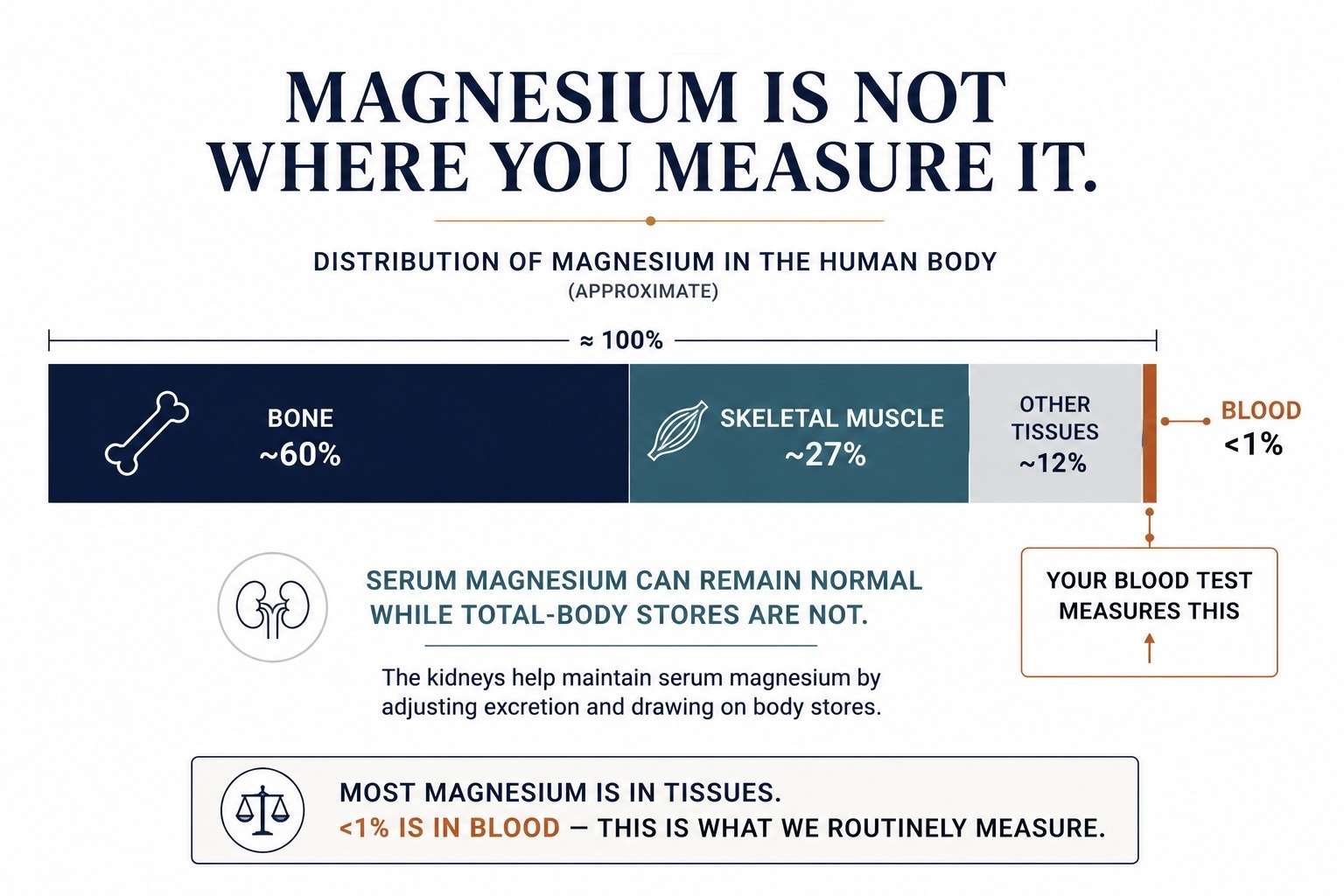
Magnesium is not where you measure it. Roughly 60% of the body's magnesium sits in bone and 27% in skeletal muscle. Under 1% is in the blood — and that fraction is what a standard blood test reports. The kidney actively defends the serum concentration by drawing on the tissue stores, so a result inside the reference range is compatible with a depleted body pool. This is the practical reason a normal magnesium test does not close the question, and the reason repletion is measured in weeks to months rather than days.
The cost of the signal-dose decision, stated
This position is not free and it should not be presented as though it were. The only authorised EU sleep claim for melatonin requires at least 0.5 mg per serving. At a signal dose that claim is unavailable, and the product therefore carries no sleep claim at all. That is a real commercial cost, accepted deliberately, because raising the amount to capture the claim would change what the formula is for. A cue that shortens sleep latency by acting as a mild sedative is a different product from one designed to sit inside the physiological range.
Melatonin, as the worked example
The right way to judge a melatonin amount is against the concentration the body itself produces at night, not against a tablet strength. Night-time melatonin in the blood peaks in the range of tens to low hundreds of picograms per millilitre — a picogram being a millionth of a milligram, which is the scale the body itself works at. Zhdanova and colleagues, publishing in Sleep in 1996, gave 0.3 and 1.0 mg to healthy volunteers: those amounts raised serum melatonin to normal nocturnal concentrations, facilitated polysomnographically assessed sleep onset, and did so without altering mood or performance the following morning.
So the physiological range for an oral dose is roughly 0.1 to 0.3 mg — enough to reproduce a normal night-time concentration, and no more. That is the range this system sits in at one to two capsules.
There is a second reason not to reach for a large amount, and it comes from where melatonin is actually made. The pineal gland is thought to account for less than 5% of the body's total melatonin; most is produced inside mitochondria throughout the body, used locally as an antioxidant, and never enters the bloodstream at all. Reiter and colleagues argue that antioxidant defence was melatonin's original function and that signalling darkness was acquired later. An oral dose cannot meaningfully top up the mitochondrial pool — that is not what it is for. What it can do is contribute to the circadian signal, and that signal is measured in picograms.
Melatonin is commonly sold at 5 or 10 mg, which produces concentrations well outside the range the body ever generates on its own. Next-morning grogginess and vivid dreams are reported disproportionately at those amounts, and the dose–response for sleep onset flattens far below them. On dependence, the honest statement is narrower than the marketing on either side: current evidence does not establish pharmacological tolerance to melatonin of the kind seen with sedative-hypnotics, and receptors becoming less responsive has been described at amounts far above what the body makes, not at amounts close to it.
So a physiological amount is the conservative choice, not the weak one — and, as set out above, it costs the product its only available sleep claim. These statements are about the melatonin literature. They are not claims about what any product does.
And the same amount is not the same dose in two people
Melatonin is metabolised almost exclusively by a single liver enzyme, CYP1A2 — and the in vivo activity of that enzyme varies as much as seventy-fold between individuals, driven by common genetic variation, by smoking, which induces it, and by caffeine, which inhibits it. Roughly half of people of European descent carry at least one gene variant that clears it slowly.
The practical consequence is uncomfortable for a category that sells one tablet strength to everybody. A slow metaboliser and a fast metaboliser taking the same 5 mg of melatonin do not receive the same exposure, and they do not receive it for the same length of time. For a slow metaboliser the concentration can still be elevated the next morning, which is one plausible route to the grogginess so many people describe. Habitual coffee drinkers are in the same position from the opposite direction: caffeine inhibits the enzyme that clears melatonin, so the same amount produces greater exposure.
There is a second reason a higher amount is not simply a stronger version of a lower one. Melatonin's effect on the body clock is phase-dependent — it shifts the clock in different directions depending on the hour it is taken relative to a person's own rhythm. A large amount taken at the wrong point can therefore push the clock the way you did not want it pushed. A minority of people consistently report agitation or worse sleep at higher amounts rather than better; that observation is well described anecdotally and clinically, if not fully explained.
This is the strongest argument for staying inside the physiological range, and it has nothing to do with caution for its own sake: a physiological amount narrows the consequences of that seventy-fold variability, while a pharmacological amount amplifies them. The people most likely to be harmed by a 10 mg melatonin product are precisely the people who cannot tell in advance that they are slow metabolisers.
Where the criticism lands
It would be dishonest to file every low amount under "signal." Some ingredients in this line sit below the amounts used in the trials that made them interesting, for reasons of formulation space and cost rather than design philosophy. Where that is true, no benefit is claimed for that ingredient — which is what EU law requires, and also what honesty requires. An ingredient listed by name and quantity with nothing promised alongside it is not a claim. It is a disclosure.
Every amount in this system is printed, so a reader can perform this criticism on it. Where a comparison product uses a proprietary blend, the same criticism cannot be performed at all — not because the amounts are adequate, but because they are not disclosed. A formula you can argue with and a formula you cannot are not in the same category of honesty.
What happens to the doses that are too low
They are reviewed. Every formula in this line goes through an annual formula audit against new trials, new EU authorisations, better raw materials and current cost — and amounts are revised when the evidence moves. Most supplement brands develop a formula once and sell it unchanged for five to ten years. Publishing the amounts, naming the ones that are weak, and committing to revise them is a slower way to build a product and a more defensible one.
14The like-for-like ingredient comparison
An ingredient-level table is only honest where both sides publish per-ingredient amounts. AG1 and IM8 use proprietary blends or aggregate complexes across a substantial part of their formulas, so a component-by-component comparison against them cannot be made from public information. That is itself one of the findings.
Longevity Complete publishes its full label, so a real comparison is possible. Below are the actives the two products share. EscapeMed figures are given across the system at the one-capsule and two-capsule level.
| Active | EscapeMed 30D (1 cap / 2 cap) | Longevity Complete (per scoop) | Comment |
|---|---|---|---|
| Elemental magnesium | 125 / 250 mg per formula, split AM and PM | 56.4 mg (malate + taurate) | Follow the recommended daily intake on the label; EU reference level for supplemental magnesium is 250 mg/day |
| Astaxanthin | 1 / 2 mg | 0.12 mg | Higher here |
| Hyaluronic acid | 50 / 100 mg | 100 mg | Equal at two capsules |
| Coenzyme Q10 | 25 / 50 mg | 100 mg | Longevity Complete is higher |
| Glycine | 167 / 335 mg, evening | 2,000 mg, morning | Longevity Complete is far higher; different window — see section 10 |
| Vitamin C | ~143 / ~287 mg across two formulas | 79.8 mg | Higher here |
| Zinc | 2.5 / 5 mg | 7.5 mg | Longevity Complete is higher |
| Vitamin B6 | ~1.5 / ~3.0 mg, split across servings | 1.4 mg | Higher here |
| Glutathione | 100 / 200 mg | — | EscapeMed only |
| MSM | 250 / 500 mg | — | EscapeMed only |
| N-acetylcysteine | 50 / 100 mg | — | EscapeMed only |
| Polypodium leucotomos | 35.8 / 71.6 mg | — | EscapeMed only |
| Ceramides, copper, choline | Present | — | EscapeMed only |
| Myo-inositol | 125 / 250 mg, morning | — | EscapeMed only |
| Ashwagandha KSM-66, L-theanine, L-tryptophan, chamomile | Present, evening only | — | EscapeMed only |
| Nicotinamide riboside (NAD precursor) | — | 300 mg | Longevity Complete only |
| Creatine | — | 3,000 mg | Longevity Complete only |
| TMG, calcium AKG, glucosamine, lion's mane, quercetin | — | Present | Longevity Complete only |
| Vitamin D3, K2, B12, selenium, chromium, thiamine, folate | — | Present | Longevity Complete only |
Table 16. Shared and exclusive actives, from both manufacturers' published labels, August 2026. Ingredients that carry no authorised EU health claim are listed by name and amount only, without any associated benefit statement.
15What we do not have
Missing actives
We do not use NMN — and neither does any EU-facing product here. NMN is not currently authorised as a food supplement ingredient in the European Union, so an EU-legal product cannot contain it. Longevity Complete uses nicotinamide riboside instead, which is authorised, and at 300 mg that is a substantial dose of an active our system does not contain at all.
Also absent: creatine, dietary fibre, greens, vitamin D3, vitamin K2, selenium and B12. Section 05 sets out why each was left out and what to buy separately instead.
What was chosen instead is depth across a narrower set — an antioxidant and connective-tissue matrix built around glutathione, astaxanthin, hyaluronic acid, CoQ10 and ceramides; five magnesium salt forms in each of the two phases, eight unique forms in total; and a separate evening formula rather than an add-on. That is a preference, not a proof of superiority.
And no trial that proves any of this
An observational pilot exists — twenty participants, single-arm, open-label, currently under peer review at the Journal of Dietary Supplements. A design of that kind cannot establish efficacy: no control group, no blinding, no randomisation, and a sample small enough that ordinary variation is a plausible explanation for much of what it found. It is preliminary and hypothesis-generating, and it is described that way in the paper.
It is reported here for one reason only: a brand that runs a small study and then talks about it as though it were proof is worse than a brand that runs none. The formulation rationale is published across six papers; the outcome evidence is one small uncontrolled pilot. Both statements are true and they should be read together.
And no marketing budget
This is a startup. There is no media spend behind this article, no agency, no celebrity, no review mass built over fifteen years. The brands compared here have all of that, and it is worth a great deal — it is the reason most people have heard of one of them and had not heard of this until now.
What exists instead is formulation and a physician who reads the literature. That is a real asset and a narrow one. It shows up in the things this document can do — print every amount, name the weak doses, cite the negative trials, tell you when to buy something else — and it does not show up anywhere a budget would. Which of those two things you value is a reasonable question, and it is yours to answer rather than ours.
16The category is already moving this way
The strongest evidence that timing matters commercially does not come from us. It comes from the market leader.
In 2025 AG1 launched AGZ, a night-time drink — its first new product in fifteen years — built around magnesium L-threonate, saffron, L-theanine, ashwagandha, valerian and lemon balm, and marketed explicitly as morning and night, a cycle of energy and restoration around the clock.
That is the timing thesis, adopted by the largest brand in the all-in-one category. The remaining difference is architecture rather than principle: AGZ is a second product added to a system originally designed around one morning serving. A phase-based system begins from the windows and formulates into them — and keeps the dose adjustable inside each one.
17Give your body thirty days — the variable nobody prices in
There is one more variable, and it is not on any label. It is the one that decides whether anything in the preceding pages matters at all.
The most common way to waste money on supplements is not choosing the wrong one. It is choosing a series of correct ones, for four weeks each. A month is long enough to spend the money and short enough to guarantee that nothing measurable has happened yet — so the product is judged a failure, replaced, and the same month is repeated with a different bottle. Done for a year, this produces twelve purchases, no accumulated effect, and no information.
Because biology does not run on a monthly cycle
The tissues these products act on renew on their own schedules, and none of those schedules is four weeks:
| Process | Time to change | What follows |
|---|---|---|
| Circadian re-entrainment | Days to roughly two weeks | The fastest thing here, and the only one you might notice inside a month |
| Intracellular magnesium repletion | Weeks to months | Serum magnesium is a poor guide; the intracellular pool fills slowly |
| Epidermal turnover | About 28 days in young skin, extending to 40–60 days with age | One complete cycle of new skin cells takes longer than most people give a product |
| Dermal collagen | Structural pool with a half-life measured in years; trials report visible change at 8–12 weeks | Nothing you do to collagen is visible in four weeks. Nothing |
| Red blood cell replacement | Around 120 days for the full population | Anything reflected in red cells is a season, not a month |
Table 17. Biological timescales, against the four-week window most supplements are judged in.
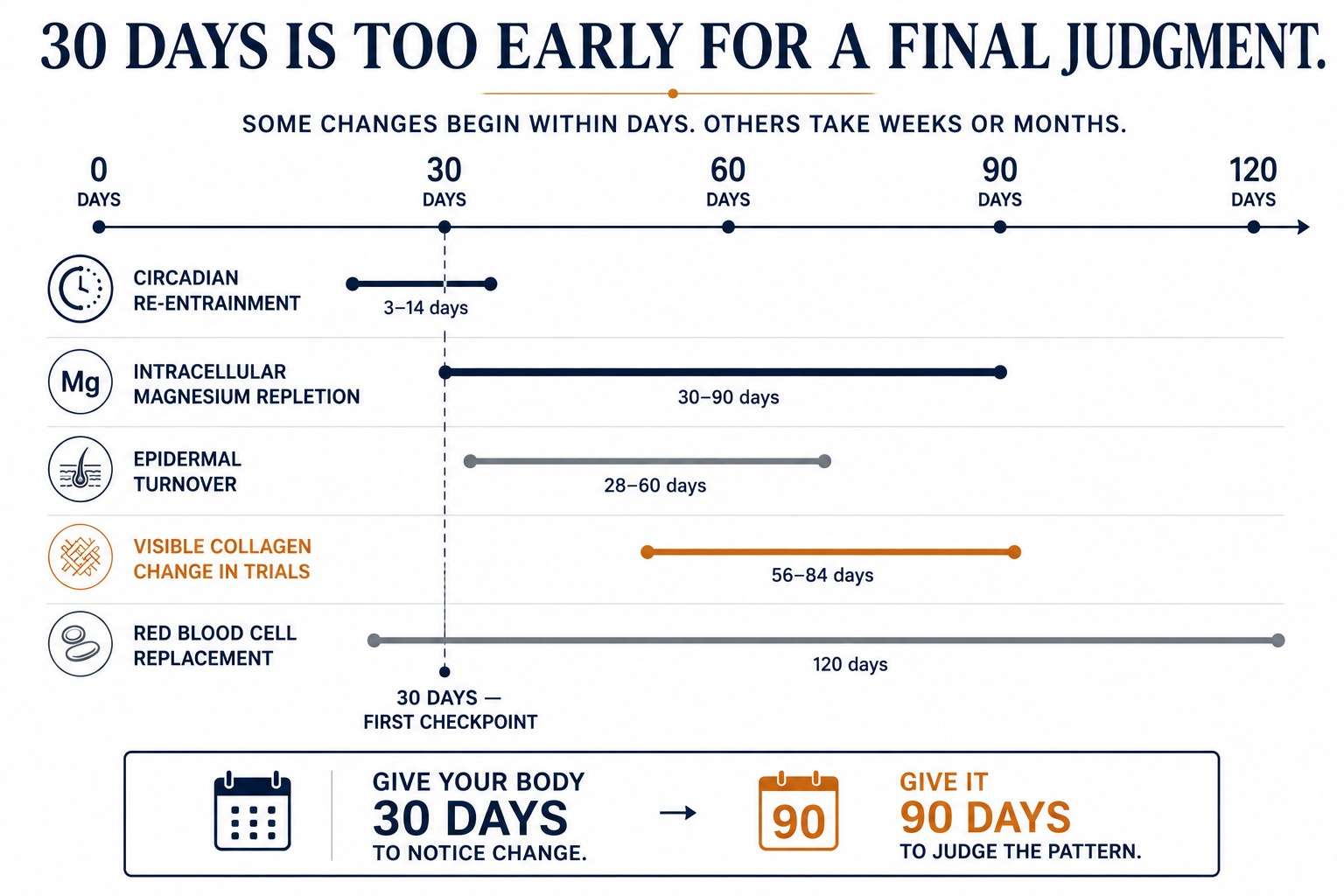
Thirty days is a checkpoint, not a verdict. Read this against the dashed line. Circadian re-entrainment is the only process here that completes inside the first month — which is why the earliest thing most people notice is their sleep and their mornings, not their skin. Intracellular magnesium repletion is only beginning at day 30. Visible collagen change in trials does not start until roughly week eight. Red cells take four months to turn over completely. Thirty days is long enough to know whether the routine has become automatic and whether anything early has shifted. It is not long enough to conclude that nothing has happened.
And because everything else in your life is already moving
This is the argument most people miss. Your nutrition varies week to week. You travel, and eat differently, and sleep worse. Your training load changes. Stress accumulates and releases. The season changes your daylight exposure. Illness, deadlines, a bad fortnight — all of it moves, constantly, and none of it is under experimental control.
Against that much variation, a supplement protocol is one of the very few inputs you can actually hold constant — and holding one thing constant is the only way to attribute anything to it. A protocol changed every month is not a variable under test. It is one more source of noise, added to a life that already has plenty.
What to actually do
- Days 1–30 — establish. Build the routine into two fixed moments until it is automatic. Judge nothing yet. The only question in month one is whether you are still doing it on day thirty.
- Days 30–90 — observe. This is the window where change, if any, becomes noticeable — and it is where the tissue timescales above start to allow it. Keep the protocol unchanged through this period, and write down what you notice rather than trusting memory.
- After 90 days — maintain, or adjust one thing. Move a formula from one capsule to two, or add a formula, or drop one. One change at a time. Two changes at once, and you have learned nothing again.
If after ninety consistent days you notice nothing, that is a real result and you should treat it as one. Stop, or change one formula — not all four, and not the whole approach. The point of a stable protocol is not that it guarantees an effect. It is that it is the only arrangement under which you ever find out.
18So which should you buy?
The EscapeMed 30D system — or any part of it.
Not because it contains more than the alternatives. It contains less: thirty actives against seventy-five or ninety. The case rests entirely on how those thirty are arranged, dosed and timed — and on the fact that you can buy one formula, one window, or all four, and change your mind later without changing product.
Stated without hedging, with every claim traceable to a table above:
- It covers the whole biological day, not half of it. Eight actives work on the evening and night phase. In the products with seventy-five and ninety ingredients, that number is zero — they are morning products, and the evening is either absent or sold to you again as a second purchase.
- It is deep where a buyer actually cares. Fourteen actives on skin and connective tissue against five or six. Eight magnesium forms against one or two. Two hundred and fifty to five hundred milligrams of elemental magnesium against fifty-six. Depth inside a domain, not length on a label.
- It is the easiest of the three arrangements to actually keep doing. Two moments. Four to eight capsules. No water beyond a glass, no scoop, no shaker, no washing up, no taste to tolerate, nothing to spill in a suitcase. Adherence is what decides whether any supplement does anything, and this is the format built for month twelve rather than week two.
- You set the dose, and you can change it. Four capsules or eight, at the same cost per capsule, adjusted whenever your training, your season or your life changes. One formula or all four. A scoop offers exactly one setting, for everyone, forever.
- Something is counting the totals. Across the whole system, not just within one product — magnesium held at a defined level and split across two windows, B6 tracked across four formulas, zinc considered against copper. A self-built stack cannot do this, and a single scoop cannot do it the moment you add anything to it.
- It excludes as deliberately as it includes. Taurate kept out of the morning; malate and succinate kept out of the evening. Adding an ingredient is available to anyone. Withholding one from a phase requires more than one formula, and a single serving cannot do it at all.
- Every amount is printed, and a physician's name is on it. No proprietary blends. Formulated by a named MD, PhD who developed the four formulas herself, documented across six papers, and who ran the protocol on her own biology for 840 consecutive tracked nights before offering it to anyone.
- It is honest about its own limits. No head-to-head trial, and only a small uncontrolled pilot. No NAD precursor, creatine, fibre or vitamin D — named, with reasons, and with instructions on what to buy separately. A brand that tells you what it cannot do is the only kind worth believing about what it can.
Replace a shelf with a system: the same thirty ingredients, arranged into two moments a day, dosed where it counts, timed to the phase they work in, counted as a whole, and simple enough that you are still taking it a year from now.
And how it compounds
Nothing here works alone, and nothing here replaces anything. Each layer adds to the one beneath it, and the effect of each depends on whether the one beneath it is in place. That is not a sales structure — it is how the biology stacks, and it is why the honest recommendation is a ladder rather than a purchase.
| Layer | What you do | What it adds |
|---|---|---|
| You, alone | Sleep, food, movement, daylight, connection | The largest effect available to anyone, measured in years of life. Free, difficult, and no product on this page substitutes for it. Start here whatever else you decide. |
| You, with timing | The same behaviours, at consistent hours — a regular sleep window, daylight early, food not at midnight | Costs nothing. Improves everything above it. Most people who take supplements have never adjusted this |
| One formula | The single formula for the phase that troubles you most — usually the evening | A defined amount, in the window it works in, instead of a guess |
| One complete window | Both formulas for that phase — Super Sleep with Magnesium PM, or Magnesium AM with Skin Renewal | The whole phase covered rather than half of it, with the overlap already accounted for |
| Both windows | All four formulas — the complete biological day | Five biological layers, every total counted across the system, nothing duplicated |
| Ninety days of it | The same protocol, unchanged, long enough for the tissue timescales in section 17 to allow anything to happen | The only arrangement under which you ever find out whether it did |
Table 18. Each row assumes the rows above it. Skipping to the bottom does not work, and no supplement makes the top row unnecessary.
The division of labour is honest and it is worth stating plainly: the base is yours and we cannot do it for you; the layer above it is ours and you should not have to assemble it yourself. Alone, you can do a great deal — most of the available effect, in fact. Together, more than either.
Fix the base first, because it is worth more than everything above it combined. Then add one layer, hold it steady for ninety days, and find out. That is the whole method — and it is the same method whether you buy from us, build your own stack, or buy nothing at all.
19How to check all of this yourself
Do not take our word for any of it. Every claim above is verifiable in roughly fifteen minutes.
- Open each brand's product page and find the supplement facts panel.
- Look for the words proprietary blend, or a complex given as a single total with many ingredients listed beneath it. Everything inside it is an unknown amount.
- Pick one ingredient you actually care about and compare the milligrams across products — not the ingredient count.
- Look up what amount the research on that ingredient used, and at what time of day it was given.
- Ask whether you could take less, or more, or only part of it — and what you would have to do to the product to manage that.
Ingredient count is the easiest thing to compare and the least informative. The dose — how much, alongside what, and when — is harder to compare and decides almost everything. Not fewer ingredients: fewer unnecessary decisions. Then give your body 30 days.
—Plain-language glossary
Every technical term used in this article, in ordinary words.
| Term | What it means |
|---|---|
| Dose of a supplement | The whole supplement you take at one time, in whatever form it comes — one capsule, one scoop, one gummy, one measure of liquid. Almost never one ingredient alone: a mixture, in fixed amounts, at a particular hour. An ingredient is a name; a dose is what your body receives. |
| Elemental magnesium | The magnesium itself, rather than the weight of the salt carrying it. 290 mg of magnesium bisglycinate contains 58 mg of elemental magnesium. |
| Counterion | The second molecule a mineral is bound to. Magnesium bisglycinate and magnesium taurate contain the same magnesium; glycine and taurine are the counterions, and they behave differently. |
| Proprietary blend | Several ingredients listed under one combined weight, so the amount of each individual one is not disclosed. |
| Cofactor | A helper substance an enzyme needs in order to work. It is not used up, so more of it does not make the enzyme work faster. |
| Repletion | Refilling a genuine shortfall. Only does something if the shortfall is real. |
| Saturable absorption | The gut can only take up so much of a nutrient at once. The more that arrives together, the smaller the share that gets through. |
| NRV | Nutrient Reference Value — the EU's daily reference amount for a vitamin or mineral, used to calculate the percentages on a label. |
| Upper level | The highest daily amount considered safe for long-term use. Usually set on tolerance, not toxicity. |
| Circadian rhythm | The roughly 24-hour cycle the body runs on. Sleep, hormones, temperature and repair all follow it. |
| Social jetlag | The gap between the hours your biology wants and the hours your schedule imposes — a time-zone shift you never travel for. |
| Phase / window | A part of the day defined by what the body is doing, not by the clock. The morning window is the first hours after waking, whenever that is. |
| Phase-dependent | An effect whose direction changes depending on the hour it happens. Melatonin shifts the clock earlier in the evening and later in the morning. |
| Single-arm, open-label | A study where everyone took the product, nobody took a dummy, and everyone knew which they were taking. It can raise questions but cannot answer them. |
| Mechanistic | Reasoning from how the body is known to work, rather than from a trial that measured the outcome. Weaker than trial evidence, stronger than a guess. |
| Physiological amount | An amount similar to what the body produces on its own, rather than a much larger one intended to force an effect. |
| Authorised health claim | A benefit statement the EU has approved for a specific nutrient. Anything not on that list cannot be claimed, however good the evidence. |
Plain-language glossary of every technical term used in this article.
—Authorised EU health claims referenced
These are the claims referenced in Table 8. All are authorised under Regulation (EU) 432/2012. Ingredients not listed here are named and quantified in this article without any associated benefit claim, because EU law does not permit one.
| Reference | Authorised wording |
|---|---|
| Energy & fatigue | Magnesium contributes to normal energy-yielding metabolism and to the reduction of tiredness and fatigue. |
| Cognitive & psychological | Magnesium and vitamin B6 contribute to normal psychological function and to the normal functioning of the nervous system. |
| Skin & collagen | Vitamin C contributes to normal collagen formation for the normal function of skin, blood vessels and bones. |
| Hair, skin & nails | Zinc, biotin, vitamin E and copper contribute to the maintenance of normal skin, hair and nails. |
| Muscle function | Magnesium contributes to normal muscle function and to electrolyte balance. |
| Hormonal activity | Vitamin B6 contributes to the regulation of hormonal activity. |
| Cell protection | Vitamin C, vitamin E, zinc and copper contribute to the protection of cells from oxidative stress. |
Authorised health claims under Regulation (EU) 432/2012, as referenced in this article.
—About the author
Silvia Samarin, MD, PhD is a physician with thirty years of clinical practice in internal medicine and cardiology, with subsequent work in chronobiology, autonomic medicine and the hormonal transition. She is the founder of EscapeMed and the formulator of all four products described here — the formulas are her own work, not licensed or white-labelled, and each was designed around a specific biological phase rather than assembled from a contract manufacturer's catalogue.
The architecture is documented in six papers published under Escape Protocol Research, covering the definition of circadian supplementation as a category, the dose rationale for each formula, and two N=1 case reports drawn from 840 consecutive nights of dual-device sleep and autonomic tracking. Much of what is argued in this article was first tested on the author before it was offered to anyone else.
That is a reason to read the argument carefully, not a reason to accept it. Everything above is checkable against published labels, and section 19 explains how.
The author is the founder of EscapeMed d.o.o. (Slovenia) and developed the four formulas discussed here. She has a direct financial interest in one of the products compared, and this should be weighed against everything the article says in its favour. This article is an editorial comparison based on publicly published manufacturer label data and does not constitute a laboratory test, a clinical comparison, or medical advice. Third-party product names and trade marks are the property of their respective owners and are used here solely for the purpose of factual identification in a comparison. Food supplements are not a substitute for a varied and balanced diet and a healthy lifestyle. No external funding was received.
Samarin, S. (2026). Your Supplement Doesn't Know What Time It Is. Thirty separate products, one scoop, or two moments a day — three ways to arrange the same thirty ingredients, compared on published label data. Escape Protocol Research. escapeprotocol.com/supplement-timing-comparison.html
- Chrononutrition and supplement timing in metabolic health and healthy aging: a narrative review, 2026.
- Chrononutrition and energy balance: how meal timing and circadian rhythms shape weight regulation and metabolic health. Nutrients 2025;17(13):2135.
- Inagawa K, et al. Subjective effects of glycine ingestion before bedtime on sleep quality. Sleep and Biological Rhythms 2006;4(1):75–77.
- Yamadera W, et al. Glycine ingestion improves subjective sleep quality in human volunteers, correlating with polysomnographic changes. Sleep and Biological Rhythms 2007.
- Bannai M, et al. The effects of glycine on subjective daytime performance in partially sleep-restricted healthy volunteers. Frontiers in Neurology 2012;3:61.
- Kawai N, et al. The sleep-promoting and hypothermic effects of glycine are mediated by NMDA receptors in the suprachiasmatic nucleus. Neuropsychopharmacology 2015;40(6):1405–1416.
- Brincat M, et al. Skin collagen changes related to age and hormone replacement therapy. Climacteric — widely cited source for the ~30% loss of skin collagen in the first five years after menopause and ~2% per year thereafter.
- Roenneberg T, Allebrandt KV, Merrow M, Vetter C. Social jetlag and obesity. Current Biology 2012 — approximately 70% of the working and studying population in industrialised countries experience at least one hour of social jetlag, and close to half experience two hours or more.
- Caliandro R, et al. Social jetlag and related risks for human health: a timely review. Nutrients 2021;13(12):4543.
- Eurofound, Sixth European Working Conditions Survey (2017) — approximately 21% of the EU workforce on shift schedules and 19% doing night work.
- Eurostat, EU Labour Force Survey (2018) — 16.7% of employed men and 9.4% of employed women worked night shifts.
- Boivin DB, Boudreau P, Kosmadopoulos A. Disturbance of the circadian system in shift work and its health impact. Journal of Biological Rhythms 2022;37:3–28.
- Claxton AJ, Cramer J, Pierce C. A systematic review of the associations between dose regimens and medication compliance. Clinical Therapeutics 2001;23(8):1296–1310 — dose-taking compliance 79% (once daily), 69% (twice), 65% (three times), 51% (four times); dose-timing compliance 59%; the once- versus twice-daily difference was not statistically significant.
- Li Y, Pan A, Wang DD, et al. Impact of healthy lifestyle factors on life expectancies in the US population. Circulation 2018;138(4):345–355.
- US Preventive Services Task Force. Vitamin, mineral, and multivitamin supplementation to prevent cardiovascular disease and cancer: recommendation statement. JAMA 2022;327(23):2326–2333.
- O'Connor EA, et al. Vitamin and mineral supplements for the primary prevention of cardiovascular disease and cancer: updated evidence report and systematic review for the USPSTF. JAMA 2022.
- Workinger JL, Doyle RP, Bortz J. Challenges in the diagnosis of magnesium status — approximately 60% of total body magnesium resides in bone and 27% in skeletal muscle; serum holds under 1%.
- Zhang Y, et al. Age and muscle function are more closely associated with intracellular magnesium, as assessed by 31P magnetic resonance spectroscopy, than with serum magnesium. Frontiers in Physiology 2019;10:1454.
- Firoz M, Graber M. Bioavailability of US commercial magnesium preparations. Magnesium Research 2001;14(4):257–262 — fractional absorption approximately 4% for magnesium oxide against 9–11% for chloride, lactate and aspartate; open-label crossover, n = 16.
- Fine KD, Santa Ana CA, Porter JL, Fordtran JS. Intestinal absorption of magnesium from food and supplements. Journal of Clinical Investigation 1991;88(2):396–402 — fractional magnesium absorption fell from 65% at the lowest intake to 11% at the highest.
- de Baaij JHF, Hoenderop JGJ, Bindels RJM. Magnesium in man: implications for health and disease. Physiological Reviews 2015;95(1):1–46.
- Tan D-X, Reiter RJ, Zimmerman S, Hardeland R. Melatonin: both a messenger of darkness and a participant in the cellular actions of non-visible solar radiation of near infrared light. Biology 2023;12:89.
- Zhdanova IV, Wurtman RJ, Morabito C, Piotrovska VR, Lynch HJ. Effects of low oral doses of melatonin, given 2–4 hours before habitual bedtime, on sleep in normal young humans. Sleep 1996;19(5):423–431.
- Härtter S, et al. Effect of caffeine intake prior to melatonin intake and CYP1A2*1F polymorphism on CYP1A2 phenotyping by melatonin — melatonin is metabolised almost exclusively by CYP1A2 and caffeine inhibits that metabolism.
- Zhou S-F, Ingelman-Sundberg M, Lauschke VM. CYP1A2 pharmacogenetics — in vivo CYP1A2 activity varies up to 70-fold between individuals through genetic variation, smoking and dietary inhibitors.
- Chang J, et al. Circadian control of the secretory pathway maintains collagen homeostasis. Nature Cell Biology 2020;22(1):74–86.
- Collagen around the clock. Nature Reviews Molecular Cell Biology 2020 — commentary on circadian regulation of collagen deposition.
- Mackenzie IS, et al. Cardiovascular outcomes in adults with hypertension with evening versus morning dosing of usual antihypertensives (TIME): a randomised controlled trial. Lancet 2022.
- Effects of morning versus evening statin administration on lipid profile: systematic review and meta-analysis.
- Trials on timing of cardiovascular medication administration: the cardiovascular circadian chronotherapy trial concept. JACC: Advances 2025.
- Regulation (EU) 432/2012 — EU Register of authorised health claims made on foods, including the melatonin claim conditions.
- EU Novel Food Union list — authorisation status of nicotinamide mononucleotide and nicotinamide riboside.
- Manufacturer product pages, checked August 2026: drinkag1.com/en-eu; im8health.com; thelongevitystore.com; gruns.co; escapemed.eu.
- Samarin S. (2026). Circadian Phase-Specific Magnesium Supplementation Using Multiple Salt Forms. Escape Protocol Research, MetaArXiv preprint.
- Samarin S. (2026). Super Sleep: A Circadian Resynchronisation Formula Based on Multi-Mechanism Non-Sedative Sleep Architecture Support. Escape Protocol Research, MetaArXiv preprint.